
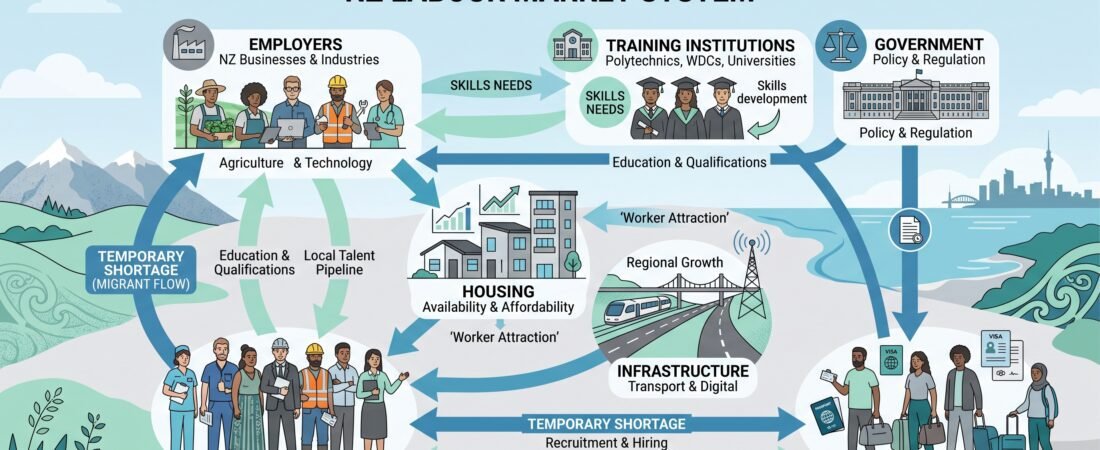
When Labour Shortages Become a Permanent Migration Model
Immigration can solve genuine labour shortages quickly.
That is one of its greatest strengths.
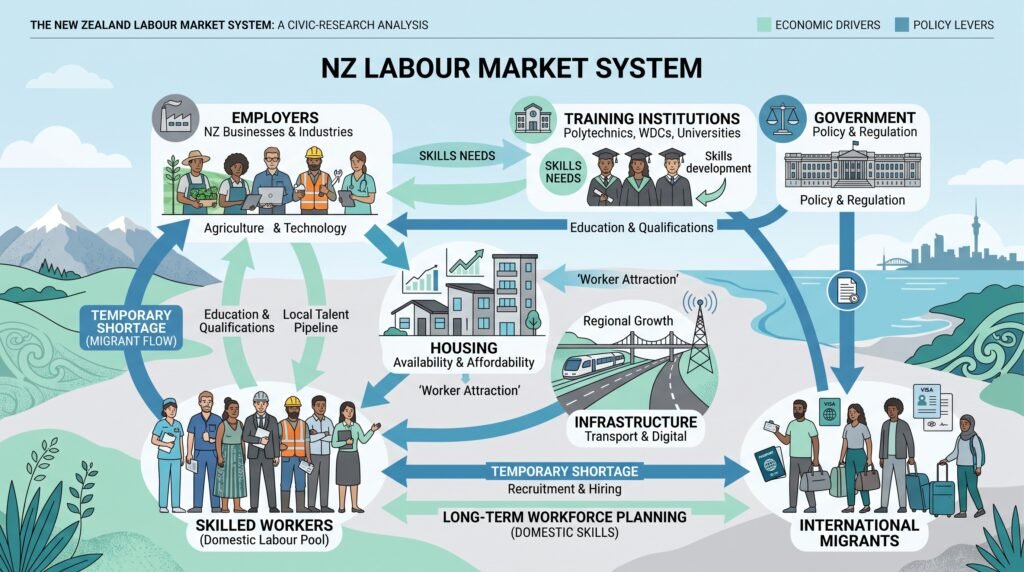
When New Zealand cannot produce enough workers with the required skills, overseas recruitment can help businesses continue operating, expand essential services and access expertise that may take years to develop locally.
But there is an important difference between using migration to respond to a shortage and allowing repeated shortages to become a permanent workforce model.
That distinction matters for New Zealand immigration policy.
Explore supporting evidence and reports in the Data & Truth library.
A Shortage Is Not Always the Same Thing
Some labour shortages are temporary.
A sudden increase in demand, a major infrastructure project, an ageing workforce or an unexpected disruption can create genuine gaps that cannot reasonably be filled immediately from the domestic labour market.
Migration can be an effective response.
But if the same industry reports the same shortage year after year, policymakers should ask a different set of questions.
Why are local workers not entering the sector?
Why are experienced workers leaving?
Are wages competitive?
Is training available?
Are working conditions sustainable?
Could investment or technology reduce the labour requirement?
At that point, the problem may no longer be simply a shortage of workers.
It may be a structural feature of the labour market.
Migration Can Become a Substitute for Adjustment
Businesses respond to the incentives around them.
If overseas recruitment is consistently cheaper, faster or easier than investing in training, technology or workforce retention, firms may rationally choose recruitment.
That does not necessarily mean employers are behaving badly.
It may mean the system is producing exactly the behaviour it encourages.
Over time, however, this can create dependence.
Industries may become accustomed to solving workforce pressure through additional labour rather than through higher productivity, better retention or improved training pipelines.
The risk is not immigration itself.
The risk is using immigration as a substitute for adjustment.
Wages Are Part of the Signal
Labour shortages normally create pressure for wages and conditions to improve.
Higher wages can attract workers, encourage training and justify investment in labour-saving technology.
But if labour supply can expand rapidly through migration, some of that adjustment pressure may be reduced.
This does not mean migration automatically suppresses wages.
Labour markets are far more complicated than that.
Skills, bargaining power, productivity, industry structure and regional conditions all matter.
But wage signals should still be part of any serious shortage assessment.
A sector that cannot attract workers at prevailing wages may face a genuine skill shortage.
It may also face a pricing problem.
Those are not always the same thing.
Training Takes Time — but That Is Why Planning Matters
One argument for migration is simple:
New Zealand needs workers now.
That is often true.
Training a nurse, engineer, technician or specialist can take years.
The existence of that delay is not an argument against migration.
It is an argument for better workforce planning.
If shortages persist for ten years, a five-year training pipeline should not still be treated as an unexpected obstacle.
Governments, employers and training institutions need clearer information about future demand.
Training capacity should respond before shortages become chronic.
Migration should complement that system, not replace it.
Housing and Infrastructure Are Part of Immigration Policy
Migration policy is often discussed as though it affects only employers and workers.
It does not.
Population growth also affects:
- housing demand
- roads and public transport
- schools
- healthcare
- water infrastructure
- electricity
- local government services
This does not mean population growth is inherently harmful.
A larger population can support economic activity, investment, skills and stronger international connections.
But workforce policy and infrastructure planning need to operate together.
A migration programme can be economically useful while still creating pressure if housing and infrastructure cannot respond at the same pace.
That is why immigration cannot be designed in isolation from the rest of the country.
Migrant Protection Matters Too
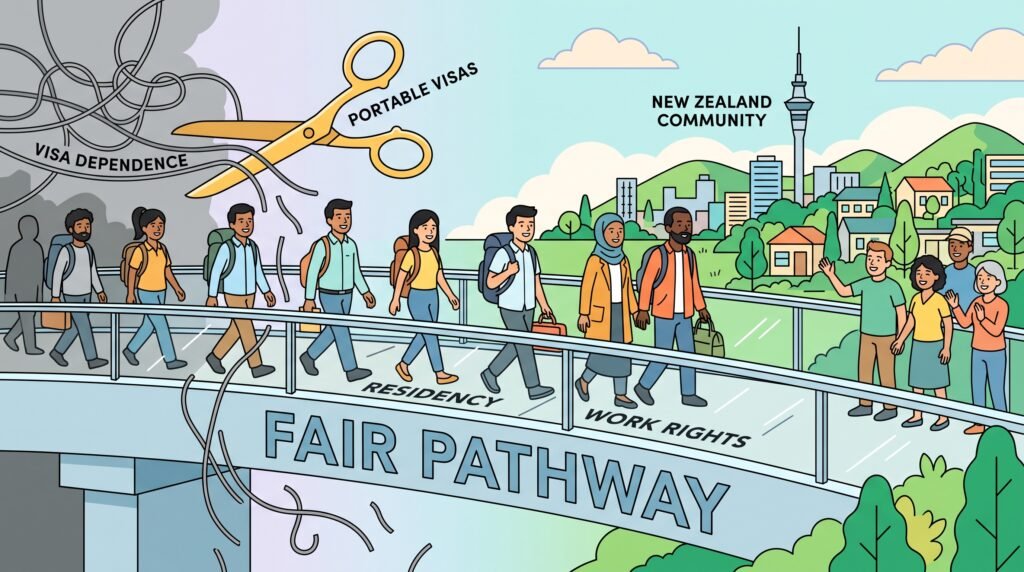
A labour market that depends on overseas workers also has responsibilities toward those workers.
Migrants can be particularly vulnerable when their visa status, employment and ability to remain in New Zealand are closely connected.
That can create an imbalance of power between worker and employer.
A strong immigration system therefore needs effective protections against:
- wage theft
- excessive recruitment fees
- unsafe working conditions
- misleading job offers
- visa-related coercion
- exploitation
Protecting migrant workers is not separate from labour-market policy.
It helps prevent businesses that follow the rules from being undercut by those that do not.
Skills Matter More Than Raw Numbers
Immigration debates frequently reduce the issue to one question:
Should New Zealand have more or fewer migrants?
That is too simple.
Two migration programmes with the same number of arrivals can have very different economic effects.
Important factors include:
- skills
- age
- occupation
- expected duration of stay
- wage level
- regional destination
- infrastructure requirements
- ability to transfer knowledge
- likelihood of long-term settlement
A highly skilled engineer, a seasonal worker, a nurse and a student all interact with the economy differently.
The composition of migration matters as much as the total number.
What Should Better Immigration Policy Ask?
A stronger system should start with better questions.
1. Is the shortage genuine?
Employers should be able to demonstrate a real labour or skill need rather than simply a preference for a larger labour pool.
2. Is the shortage temporary or structural?
Short-term gaps may justify rapid recruitment.
Persistent gaps require workforce planning.
3. What is being done domestically?
Training, retention, wages and technology should form part of the assessment.
4. Can infrastructure absorb additional population?
Housing and public services should be considered alongside labour demand.
5. Are migrants adequately protected?
Labour-market flexibility should not depend on vulnerable workers having fewer practical rights.
6. Does migration improve national capability?
The strongest migration settings should help New Zealand accumulate skills, productivity and knowledge over time.
Explore possible reform approaches in the FIXNZ Solution Lab.
The FIXNZ Perspective
Immigration is not simply a question of being “for” or “against” migration.
New Zealand will continue to need international skills.
A small country cannot realistically produce every specialist, worker or capability domestically at all times.
The more important question is what role migration should play in the wider economic system.
A well-designed system should allow New Zealand to respond quickly to genuine shortages while continuing to strengthen domestic skills, workforce participation and productivity.
It should protect migrants from exploitation.
It should connect labour-market planning with housing and infrastructure capacity.
And it should make persistent shortages visible rather than allowing them to become permanent without scrutiny.
The goal should not be to eliminate migration dependence entirely.
It should be to ensure migration strengthens national capability rather than quietly substituting for it.
Explore the full Immigration analysis on FIXNZ.