
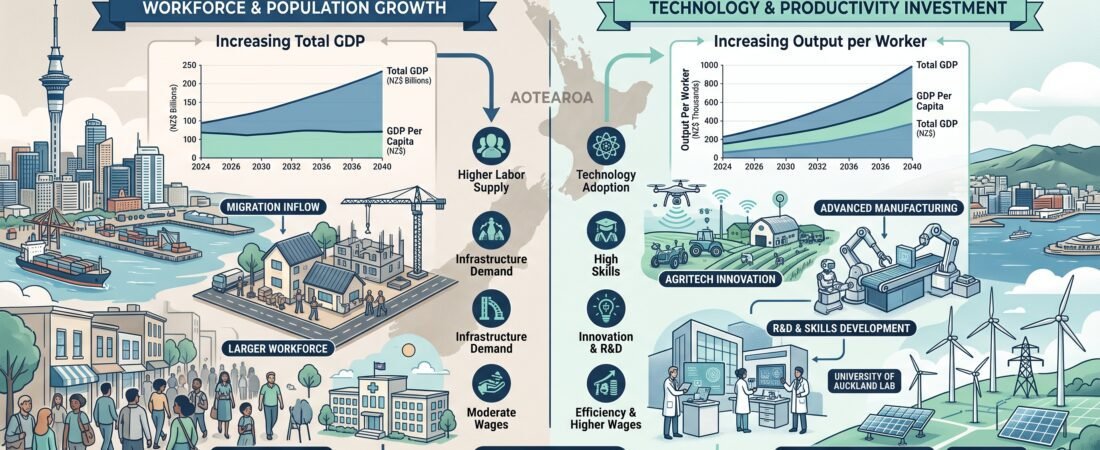
Why Productivity Matters More Than Headline GDP
Economic growth is usually reported through GDP.
GDP matters.
It tells us whether the total value of goods and services produced in the economy is rising or falling.
But it does not answer every question households care about.
An economy can become larger without becoming much more productive.
That distinction matters for New Zealand productivity.
Explore supporting economic evidence in the Data & Truth library.
A Bigger Economy Is Not Always a Better Economy
Total GDP can rise for several reasons.
There may be:
- more people
- more workers
- longer working hours
- higher prices
- more investment
- better technology
- higher productivity
These are not the same kind of growth.
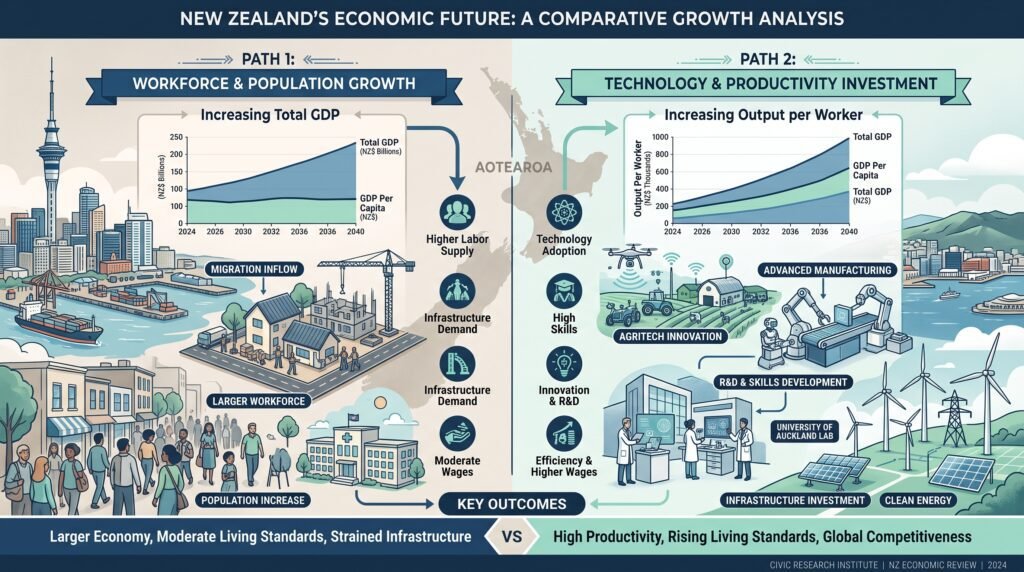
If an economy grows mainly because more people are working, total output can increase even if output per person changes very little.
That can make headline GDP look healthy while households experience only modest improvements in living standards.
Productivity Changes What an Hour of Work Can Produce
Productivity is about how much value can be produced from labour, capital and technology.
At its simplest, higher productivity means producing more value from the same amount of effort.
That matters because living standards cannot rise indefinitely simply by asking people to work more hours.
There are practical limits to:
- labour-force participation
- population growth
- working time
Long-term prosperity depends increasingly on what each worker and each hour can produce.
Why Productivity Matters for Wages
Businesses can only sustain higher wages over the long term if workers generate enough additional value to support them.
Wages can rise temporarily for other reasons.
Labour shortages, regulation or bargaining power may increase pay.
But if productivity does not improve, businesses eventually face pressure through:
- higher prices
- lower profits
- reduced hiring
- weaker investment
- business closures
Productivity provides the economic foundation that makes higher real wages easier to sustain.
GDP Per Person Tells a Different Story
Population growth can increase total GDP.
That does not automatically mean the average person is becoming better off.
GDP per capita divides economic output by population.
It provides a different perspective.
Even that measure is incomplete because it does not capture everything that matters to wellbeing.
But comparing total GDP with GDP per person can help distinguish between:
an economy that is growing because it is larger
and
an economy that is becoming more productive.
That distinction is important in a country where population growth can make a meaningful contribution to headline economic growth.
Productivity Is Not About Making People Work Harder
The word productivity can sound like a demand for employees to work faster.
That is not the main issue.
Productivity often improves because people are able to work more effectively.
For example:
A builder using better equipment can complete more work in the same time.
A logistics company using better software can reduce wasted journeys.
A manufacturer using automation can produce more with fewer repetitive tasks.
A professional using better information systems can spend less time on administration.
The improvement comes from tools, organisation, investment and knowledge — not necessarily from greater physical effort.

Investment Matters
Productivity often requires capital.
Businesses need money to invest in:
- equipment
- software
- automation
- research
- training
- infrastructure
- new production methods
If investment is weak, businesses may continue using older processes even when better technology exists.
This can create a cycle.
Low productivity limits profits and wages.
Weak profitability reduces investment.
Low investment then reinforces weak productivity.
Breaking that cycle can be difficult.
Skills Matter Too
Technology alone does not create productivity.
People need the skills to use it effectively.
Education, vocational training and workplace learning therefore matter.
But skills policy also needs to respond to the economy that actually exists.
Training large numbers of people for occupations with weak demand does not automatically improve productivity.
Skills, technology, industry demand and investment need to work together.
Infrastructure Can Raise or Reduce Productivity
A productive business does not operate in isolation.
It depends on:
- transport
- electricity
- telecommunications
- water
- ports
- digital networks
- reliable public institutions
Congestion can waste working hours.
Electricity constraints can limit investment.
Slow consenting can delay projects.
Poor digital infrastructure can reduce access to markets.
Infrastructure is therefore part of productivity policy.
Competition Creates Pressure to Improve
Businesses often improve when competition gives them a reason to do so.
Competition can encourage firms to:
- adopt better technology
- reduce waste
- improve management
- lower prices
- develop new products
But competition alone is not enough.
Businesses also need access to capital, workers and markets.
The policy challenge is creating an environment where firms both face pressure to improve and have the ability to respond.
Exports Can Matter More for Small Economies
New Zealand has a relatively small domestic market.
That creates limitations.
A business serving only the local market may struggle to achieve the scale needed to justify major investment.
Export markets can expand the potential customer base.
International competition can also expose firms to:
- new technology
- higher standards
- larger markets
- specialist knowledge
That is one reason productive, high-value exports matter for long-term economic performance.
Immigration and Productivity Are Related but Different
Migration can increase the size of the labour force.
It can also improve productivity when migrants bring scarce skills, entrepreneurship, investment or international connections.
But simply increasing the number of workers does not automatically raise productivity per worker.
That is why population growth and productivity should be analysed separately.
A larger workforce can produce a larger economy.
A more productive workforce can help produce higher living standards.
New Zealand may benefit from both.
But they are not interchangeable.
What Should Better Economic Policy Ask?
A stronger productivity strategy should begin with practical questions.
1. Are businesses investing enough?
If not, what barriers are preventing investment?
2. Are skills aligned with future demand?
Training systems need to respond to changing industries and technology.
3. Is infrastructure helping or constraining firms?
Transport, energy and digital capacity all affect productivity.
4. Are productive businesses able to scale?
Access to finance and international markets matters.
5. Does regulation create value proportional to its cost?
Necessary protections should remain, while avoidable friction should be identified.
6. Are we measuring the right outcomes?
Headline GDP should be considered alongside productivity, GDP per person, wages and household living standards.
Explore possible economic reform ideas in the FIXNZ Solution Lab.
The FIXNZ Perspective
Economic growth matters.
But the quality of growth matters more.
A country can increase total GDP by adding more people, more working hours and more activity.
That may be useful.
But those sources of growth have limits.
Long-term prosperity depends increasingly on producing more value from the resources New Zealand already has.
That means better investment.
Better technology.
Better skills.
Better infrastructure.
More productive businesses.
And stronger connections to markets beyond New Zealand.
The central question should not simply be:
Is the economy getting bigger?
It should also be:
Is New Zealand becoming better at creating value?
Explore more economic analysis through FIXNZ and the Data & Truth library.