

A New Zealand immigration debate should no longer be based on yesterday's assumptions.
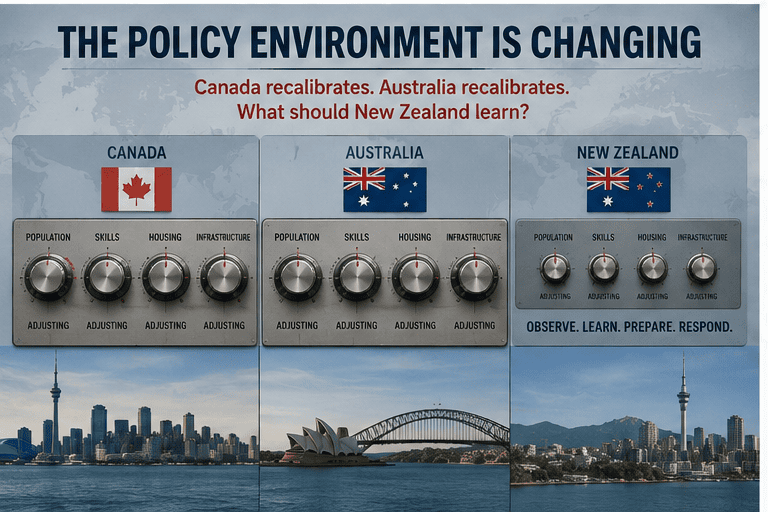
New Zealand has long looked to countries such as Australia and Canada when shaping its approach to immigration, labour markets, international education and social policy. But those countries are now recalibrating. New Zealand should pay attention.
For decades, Canada, Australia and New Zealand shared a broadly similar assumption: immigration could support population growth, fill labour shortages, expand the tax base and strengthen links with the global economy.
That model delivered real benefits.
But policies designed for one economic environment do not necessarily remain appropriate forever.
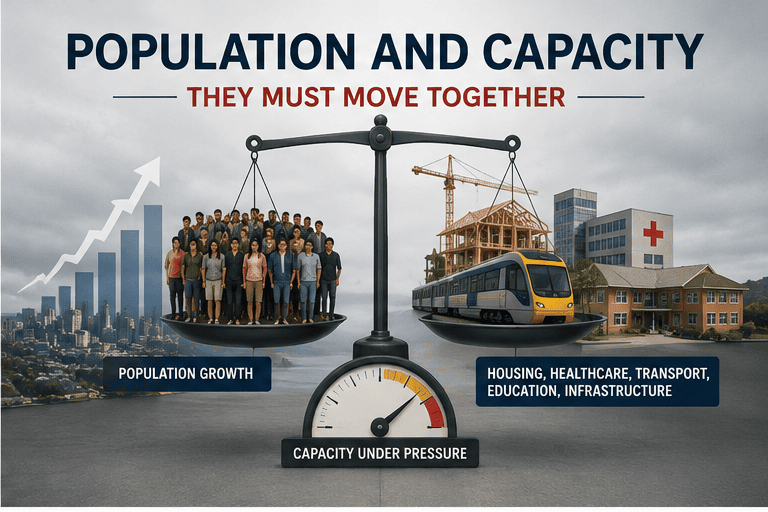
Housing shortages, infrastructure constraints, healthcare capacity, weak productivity growth and rapidly increasing populations have forced comparable countries to reconsider how immigration fits into a wider national strategy.
The important question for New Zealand is therefore not whether immigration is "good" or "bad".
It is much more practical:
Have the conditions around us changed enough that New Zealand also needs to change?
Canada has already changed direction
Canada provides perhaps the clearest warning against assuming that very high population growth can continue independently of housing and infrastructure capacity.
The Canadian government is now explicitly pursuing what it describes as a return to more sustainable immigration levels.
Under Canada's 2026–2028 Immigration Levels Plan, permanent resident admissions are being stabilised while targets for new temporary residents are being reduced.
Canada has also committed to reducing temporary residents to less than 5% of the country's total population by the end of 2027.
The Canadian government's explanation matters.
It specifically links immigration management with pressure on housing, infrastructure and public services, while simultaneously maintaining pathways for skilled migrants needed by the economy.
This is not the abandonment of immigration.
It is a change in philosophy.
The objective is increasingly becoming:
select what the economy needs, retain valuable skills, and keep total population growth within the country's capacity to absorb it.
That distinction matters enormously.
Australia is recalibrating too
Australia is following its own version of the same adjustment.
Net overseas migration has fallen substantially from its post-COVID peak, while temporary migration and international student settings have been tightened.
Australia has also introduced stronger integrity measures intended partly to reduce abuse and repeated temporary migration pathways.
But Australia provides another important lesson.
Reducing migration pressure does not necessarily mean abandoning skilled immigration.
Australia continues to maintain a substantial permanent migration programme, with a strong emphasis on skilled migration and productivity.
That suggests a more sophisticated policy direction:
less emphasis on migration as a source of raw population growth, and more emphasis on migration as an instrument of economic strategy.
New Zealand should study that distinction carefully.
New Zealand cannot simply run yesterday's policy forever
New Zealand is smaller than both Australia and Canada.
That makes our margin for policy error smaller as well.
A population increase that Australia can absorb across multiple large cities may create much greater pressure when concentrated in Auckland, Christchurch or a handful of other New Zealand centres.
Housing construction takes time.
Hospitals take time.
Schools take time.
Transport networks take time.
Water infrastructure takes time.
Training doctors, engineers, nurses and skilled tradespeople takes time.
Population growth, however, can occur much faster.
When these two speeds become disconnected, immigration may continue to increase GDP while simultaneously reducing the lived quality of growth.
That is the distinction New Zealand needs to understand.
GDP growth and improvement in living standards are not automatically the same thing.
Immigration should become part of infrastructure planning
New Zealand's immigration debate is often reduced to a number:
How many migrants should we accept?
That may be the wrong starting question.
A better system would ask:
How much additional population can New Zealand's housing, healthcare, transport, education and infrastructure systems reasonably absorb?
Immigration settings could then respond to that capacity.
This would turn immigration from an isolated political target into part of national infrastructure planning.
For example, if housing construction and infrastructure investment accelerate substantially, migration capacity could increase.
If housing shortages intensify and hospitals or schools become overloaded, intake could moderate.
This would create something New Zealand currently needs badly:
a feedback mechanism between population policy and national capacity.
Selectivity matters more than raw numbers
Canada and Australia are also demonstrating another important shift.
The future immigration debate may increasingly be about who a country needs, rather than simply how many people it admits.
New Zealand should prepare for the same transition.
A modern immigration strategy could place greater weight on occupations and capabilities that increase national productive capacity:
- engineering
- advanced manufacturing
- healthcare
- construction
- science and research
- technology
- infrastructure
- internationally competitive entrepreneurship
That does not mean every migrant must work in a narrowly defined "high-skill" profession.
New Zealand will continue to need workers across many industries.
But immigration policy should increasingly ask whether migration strengthens the productive structure of the economy rather than merely expanding domestic consumption.
New Zealand should not wait for a crisis
Policy reform is easiest before public confidence collapses.
Canada's experience demonstrates how quickly political attitudes toward immigration can change when population growth becomes associated with housing shortages and pressure on public services.
New Zealand should avoid reaching that point.
The objective should not be to copy Canada.
Nor should we copy Australia.
Their economies, geography and population structures are different from ours.
The lesson is simpler:
When comparable countries change direction, New Zealand should understand why before assuming our old settings remain appropriate.
What FIXNZ proposes
New Zealand should establish a regular National Population and Capacity Review linking immigration settings with measurable domestic conditions.
The review should examine:
- housing completions and housing affordability
- hospital and primary healthcare capacity
- school and tertiary education capacity
- transport and water infrastructure
- labour shortages
- unemployment and wage conditions
- productivity growth
- regional population pressures
- migrant employment outcomes
- the fiscal contribution and cost of population growth
Immigration settings should then be adjusted against this evidence rather than determined primarily through political instinct or short-term labour-market pressure.
New Zealand should also systematically benchmark itself against Australia, Canada and other comparable small advanced economies.
Not because they always make better decisions.
But because their successes — and their mistakes — provide information that New Zealand does not need to rediscover at its own expense.
A country must be willing to learn
New Zealand has often benefited from observing larger comparable democracies.
We should continue doing so.
But following another country's policy with a five-year delay is not strategy.
The world after the pandemic is different.
Population pressures are different.
Housing conditions are different.
Geopolitics is different.
Competition for highly skilled people is different.
Canada is recalibrating.
Australia is recalibrating.
New Zealand does not automatically need to follow either country.
But we should at least open our eyes, examine what changed, and prepare to change ourselves when the evidence requires it.
That is not anti-immigration.
It is not isolationism.
It is simply responsible government.
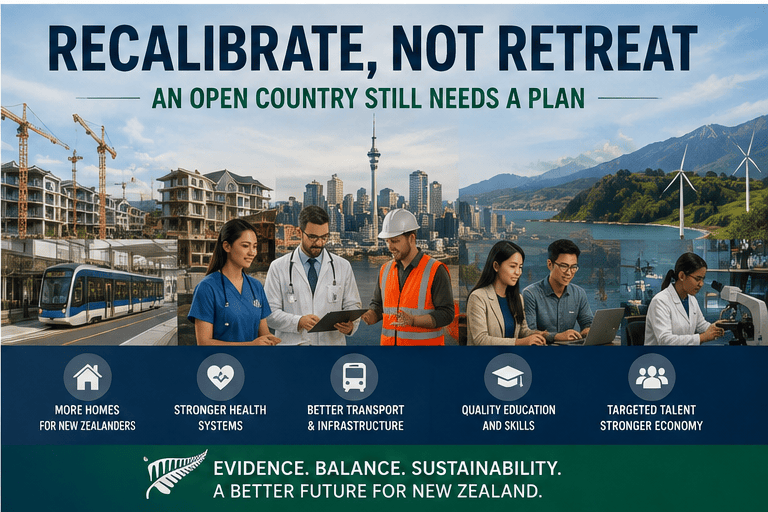
An open country still needs a plan.