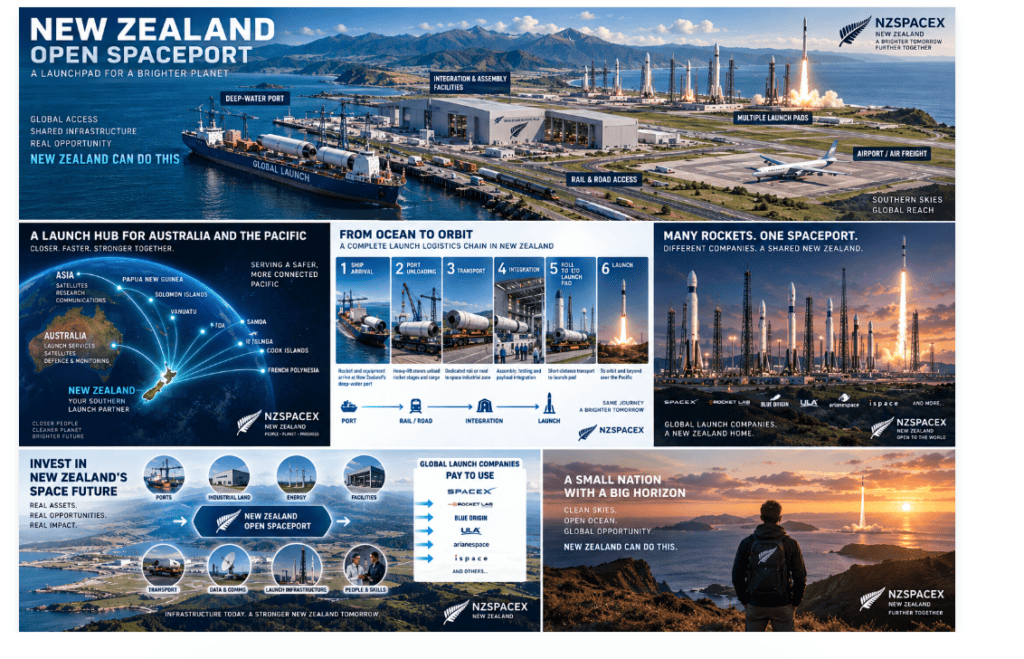
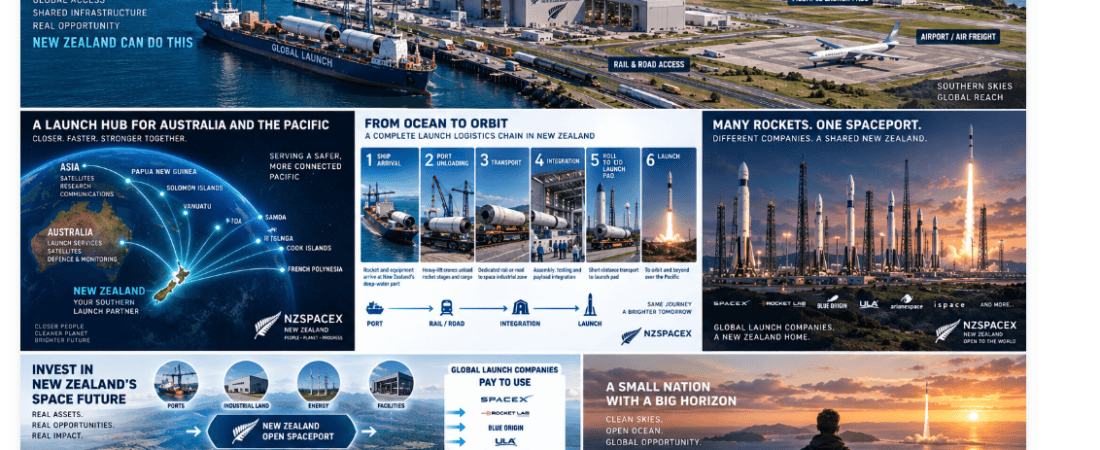
We do not need to build every rocket. We need to build the place where rockets come to fly.
In August 2026, NASA’s Nancy Grace Roman Space Telescope left Earth aboard a SpaceX Falcon Heavy, beginning its journey toward the Sun–Earth L2 region roughly 1.6 million kilometres away.
It was an extraordinary scientific mission.
But for New Zealand, there is another lesson hidden inside that launch.
A telescope can be built by one organisation.
Its instruments can come from another.
Its science can involve institutions across the world.
And the transportation itself can be purchased from a commercial launch provider.
That matters.
Because spaceflight is changing.
Launch is slowly becoming not only a national capability, but also a commercial transport service.
And when transportation becomes a service, countries do not have to own every vehicle in order to participate.
That is where New Zealand should think differently.
We do not need to manufacture every rocket.
We can build the infrastructure the world needs to launch them.
That is a very different ambition.
And it is one New Zealand can realistically pursue.
NEW ZEALAND, WE ALREADY HAVE A START
We are not beginning from zero.
New Zealand has already demonstrated that orbital launch from this country is possible.
We already have a functioning space regulatory environment.
We already have engineers, aerospace companies, universities, advanced manufacturing capability and international space relationships.
We already sit beside one of the largest open ocean areas on Earth.
We already have ports.
We already have airports.
We already have land.
We already have energy infrastructure.
We already understand international logistics.
The pieces exist.
The opportunity is to connect them.
Instead of asking:
Can New Zealand build the world’s biggest rocket?
We should ask:
Can New Zealand build one of the world’s most useful places to launch rockets?
The answer is yes.
BUILD THE NEW ZEALAND OPEN SPACEPORT
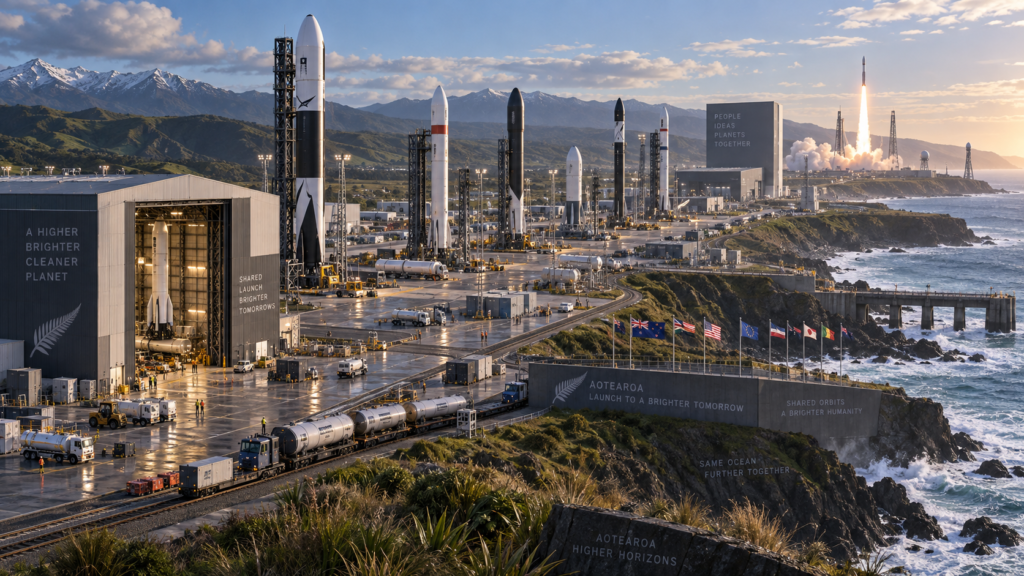
Imagine a new kind of national space infrastructure.
Not a launch site built for one company.
Not a private complex that works with only one rocket.
But a shared platform designed from the beginning for multiple international launch providers.
A:
NEW ZEALAND OPEN SPACEPORT
The principle is simple.
Rocket companies bring the rocket.
New Zealand provides the infrastructure.
That infrastructure could include:
- a deep-water port
- heavy-lift unloading facilities
- rocket storage
- integration buildings
- clean rooms
- payload preparation facilities
- propellant infrastructure
- dedicated roads
- rail access
- airport access
- heavy air-freight capability
- testing facilities
- launch pads
- tracking systems
- communications
- data centres
- safety zones
- Pacific launch corridors
This would change the economics of launching from New Zealand.
A foreign launch company would not necessarily need to build an entire spaceport from scratch.
It could arrive, integrate, test, launch and pay for the infrastructure it uses.
Just as an airline does not build a new airport every time it enters a new country.
That is the idea:
SPACEPORT AS A SERVICE
And New Zealand can build it.
OUR DEEP-WATER PORTS COULD BECOME PART OF THE SPACE INDUSTRY
One of the biggest practical problems in large-scale launch operations is not always the launch itself.
It is logistics.
Large rockets contain enormous structures.
Stages can be tens of metres long.
Some components are difficult or expensive to move through ordinary road networks.
This is where New Zealand can think like a logistics nation.
We already understand ports.
We already understand freight.
We already connect international shipping, road transport, aviation and industrial zones.
Now imagine combining those capabilities into a dedicated space logistics corridor.
A rocket arrives by ship.
It is unloaded directly into a secure industrial zone.
It moves by dedicated road or rail.
It enters a large integration building.
Its stages are checked.
Its payload is installed.
The completed vehicle moves to the launch pad.
Then it launches over the Pacific.
The entire chain becomes:
SHIP
→ PORT
→ RAIL
→ INTEGRATION
→ LAUNCH PAD
→ SPACE
That is not science fiction.
It is infrastructure planning.
And infrastructure is something New Zealand knows how to build.
WE CAN STOP MAKING EVERY ROCKET COMPANY BUILD THE SAME THINGS AGAIN
Suppose several launch companies want access to the South Pacific.
Under the traditional model, each one may need to build its own facilities.
Company A builds its own pad.
Company B builds another.
Company C builds another.
Each needs roads.
Storage.
Fuel systems.
Control rooms.
Tracking systems.
Warehouses.
Security.
Utilities.
Staff facilities.
Much of that infrastructure may remain unused for long periods between launches.
There is a better model.
Share what can be shared.
Specialise only where necessary.
That is how airports work.
That is how ports work.
That is how industrial parks work.
And that is how a future spaceport can work.
New Zealand could build:
Launch Pad A
for smaller launch vehicles.
Launch Pad B
for medium or heavy vehicles.
Launch Pad C
for future reusable systems.
Behind them, companies could share:
- logistics
- electricity
- communications
- tracking
- warehousing
- security
- integration infrastructure
- data systems
- transport corridors
Different rockets.
Different companies.
One national platform.
One New Zealand spaceport.
Many global customers.
WE DO NOT HAVE TO BET ON ONE ROCKET COMPANY
This model is also important for New Zealand investors.
Investing directly in a rocket company is difficult.
A rocket can fail.
An engine can fail.
A funding round can fail.
A competitor can lower prices.
A technical programme can be delayed for years.
But infrastructure is different.
New Zealand investors could invest in:
- port facilities
- industrial land
- warehouses
- integration buildings
- power systems
- data centres
- transport infrastructure
- testing facilities
- communications
- clean rooms
- launch infrastructure
- engineering services
That means local capital does not have to predict which rocket company will win.
It can invest in the infrastructure that many rocket companies may need.
That is a powerful idea.
We do not have to pick the winning rocket.
We can own part of the place where the winners come to launch.
SPACEX CAN BE PART OF THE STORY — BUT NOT THE WHOLE STORY
NZSPACEX exists because we believe New Zealand should actively pursue opportunities created by companies such as SpaceX.
But a serious national space strategy should be bigger than one company.
SpaceX could come.
Rocket Lab could use infrastructure.
Australian launch companies could come.
American companies could come.
European companies could come.
Asian companies could come.
Future companies that do not yet exist could come.
The objective should not be to build:
a SpaceX base in New Zealand.
The objective should be to build:
a New Zealand platform for the global launch economy.
That distinction matters.
It means New Zealand owns the strategic position.
It means New Zealand becomes the host.
It means New Zealand becomes the connector.
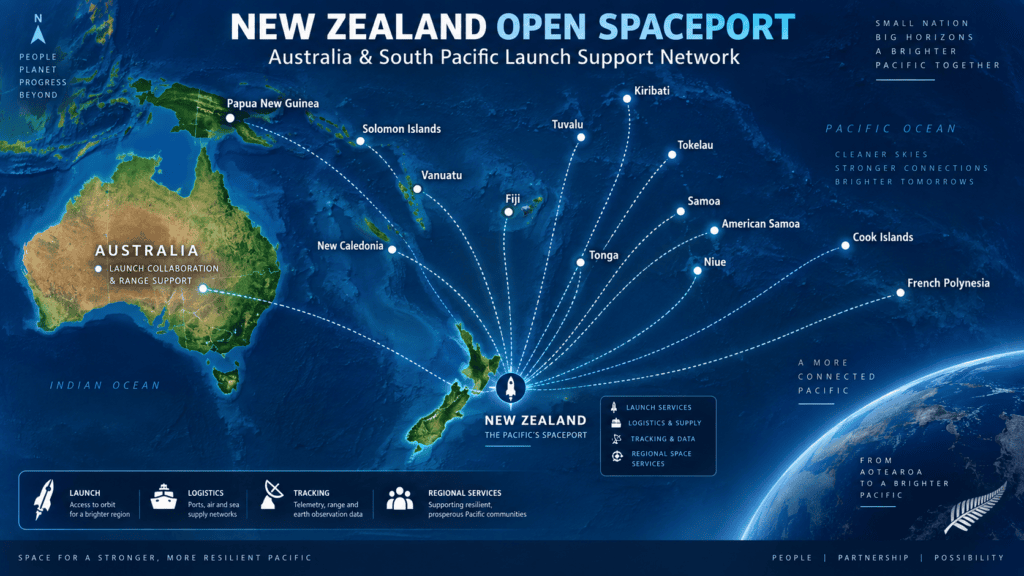
NEW ZEALAND CAN SERVE MORE THAN NEW ZEALAND
Our potential market is not limited to five million people.
We sit beside Australia and in the heart of the South Pacific.
The region includes countries and territories that may increasingly need access to:
- communications satellites
- weather satellites
- maritime monitoring
- disaster observation
- climate research
- scientific payloads
- Earth observation
- navigation services
Not every Pacific country needs its own launch site.
Not every country needs to build rockets.
But many may need access to space.
New Zealand can help provide that access.
We can become a regional service hub.
A satellite could be designed in Australia.
A scientific payload could come from a Pacific university.
Components could come from Asia.
Integration could happen in New Zealand.
Launch could happen from New Zealand.
Data could be processed in New Zealand.
That is how a regional ecosystem starts.
THE LAUNCH PAD IS ONLY THE BEGINNING
The real value is not simply launching rockets.
The real value is what grows around launch activity.
First comes logistics.
Then testing.
Then integration.
Then maintenance.
Then manufacturing.
Then software.
Then communications.
Then robotics.
Then data processing.
Then AI.
Then research.
Then finance.
Then insurance.
Then education.
Then more companies arrive because the first companies are already here.
A spaceport can become the centre of a much larger industrial cluster.
This is how New Zealand can build a space economy without trying to copy the United States.
We do not need to replicate everything.
We need to specialise intelligently.
NEW ZEALAND CAN BUILD THE PLATFORM
For too long, small countries have been told to think small.
But New Zealand does not need to compete by size.
We can compete by location.
By infrastructure.
By regulation.
By reliability.
By access to the Pacific.
By engineering quality.
By political stability.
By logistics.
By being easy to work with.
That combination has value.
A future launch company may not ask:
“Which country can build the biggest rocket?”
It may ask:
“Where can we launch safely, reliably and economically?”
New Zealand should be one of the answers.
IMAGINE THE SCENE
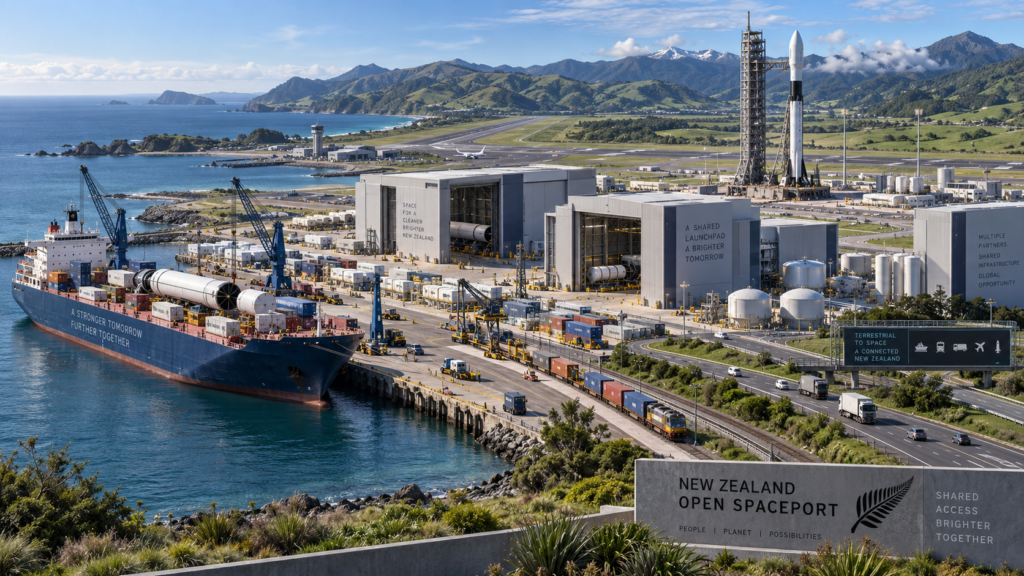
A heavy transport ship arrives at a New Zealand deep-water port.
On deck are rocket stages manufactured overseas.
Cranes unload them.
A dedicated train moves them toward a nearby integration complex.
Inside a massive assembly building, engineers prepare the vehicle.
A satellite arrives by cargo aircraft.
Its payload is integrated.
Nearby, another rocket is already standing on a launch pad.
A different company is preparing another vehicle several kilometres away.
One rocket lifts off.
Another arrives by sea.
Another payload is being tested.
New Zealand engineers are working alongside teams from several countries.
Local companies provide maintenance.
Local firms provide logistics.
Local data centres process satellite information.
Local investors own part of the infrastructure.
Local universities train the next generation of engineers.
That is not simply a launch site.
That is an industry.
And it can happen here.
WE CAN DO THIS
New Zealand does not need to build every rocket.
We do not need to become America.
We do not need to become China.
We do not need to reproduce every part of the global space industry.
We need to understand what New Zealand is uniquely positioned to provide.
We have the Pacific.
We have ports.
We have land.
We have launch experience.
We have regulation.
We have engineering capability.
We have global connections.
We have investors.
We have the ability to build infrastructure.
What we need now is ambition.
Not unrealistic ambition.
Focused ambition.
The kind that says:
Here is what the world will need.
Here is what New Zealand is good at.
Let us connect the two.
That is how a small country creates a large opportunity.
NEW ZEALAND OPEN SPACEPORT
One country.
Many launch companies.
One Pacific gateway.
A new space industry built around access, infrastructure and service.
And perhaps one day the message to the global launch industry can be very simple:
BRING YOUR ROCKET.
NEW ZEALAND WILL PROVIDE THE PORT, THE PAD AND THE PATH TO SPACE.
We can build this.
We can host this.
We can make New Zealand part of the world’s space infrastructure.