
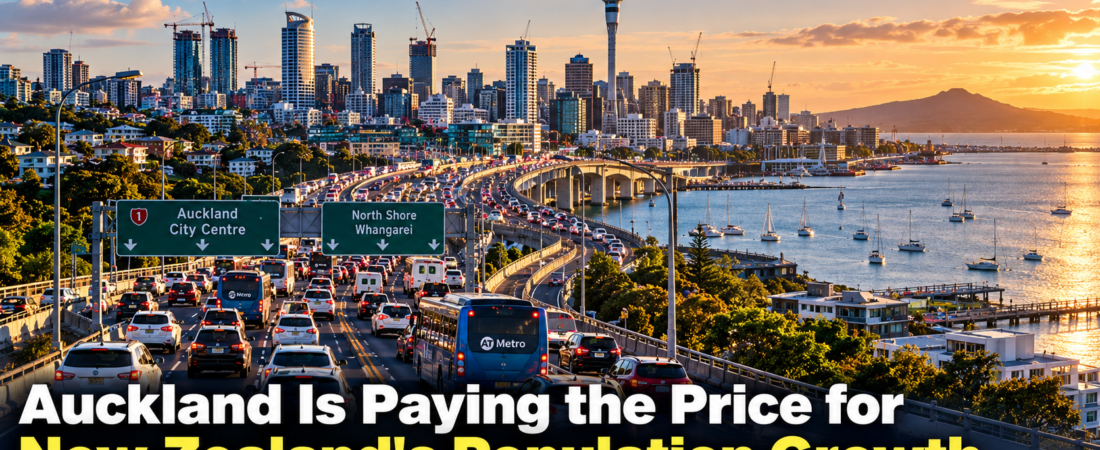
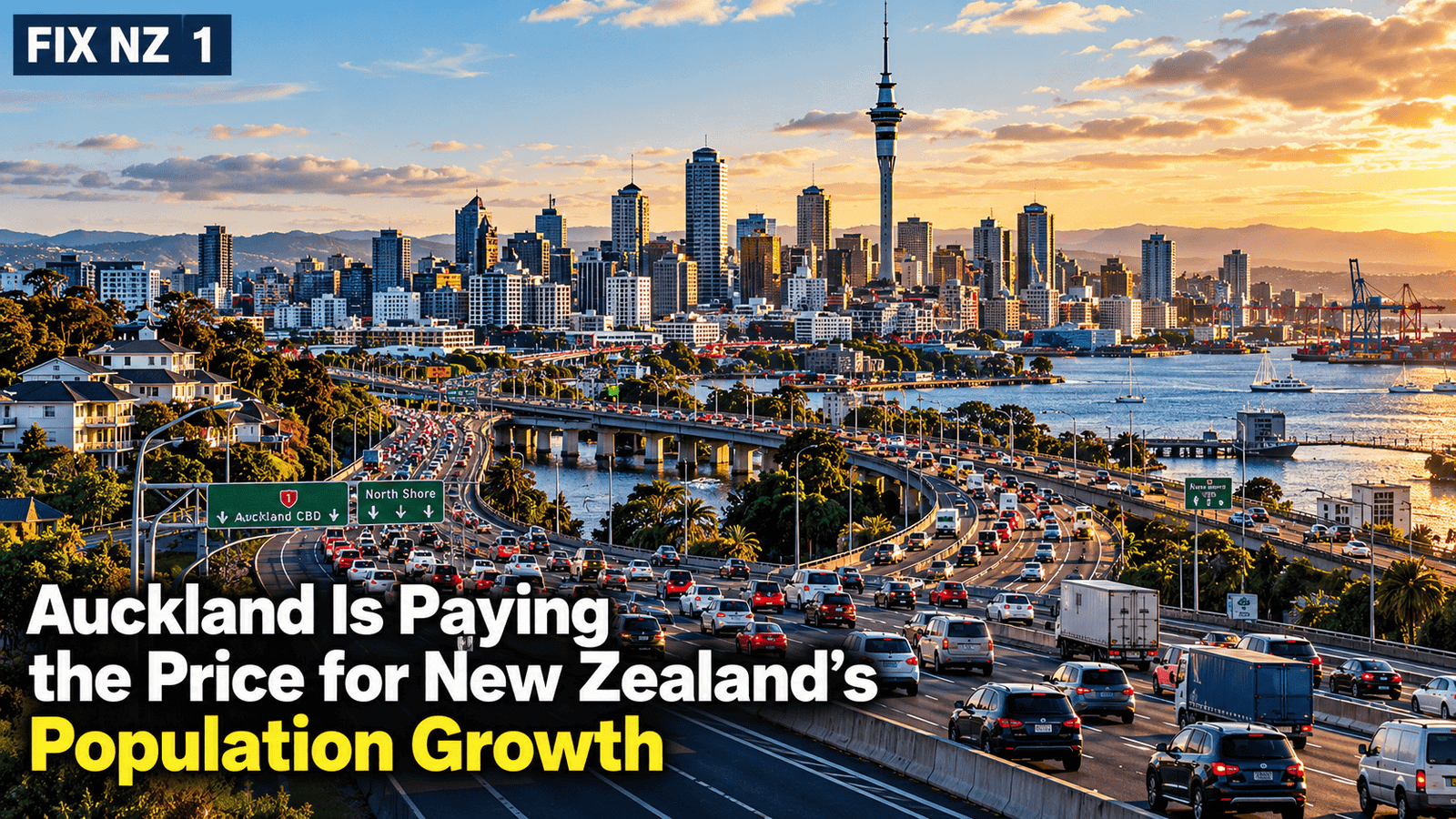
Auckland is paying for a national population policy that has not been matched by timely local investment. New migrants are drawn to the country’s largest employment centre, but roads, healthcare, schools and housing infrastructure do not expand at the same speed. The shortfall is passed to residents through congestion, stretched services and higher daily costs.
The issue is not whether Auckland should exist as a growing city. It is whether New Zealand should keep adding people before it has built the capacity to serve them.
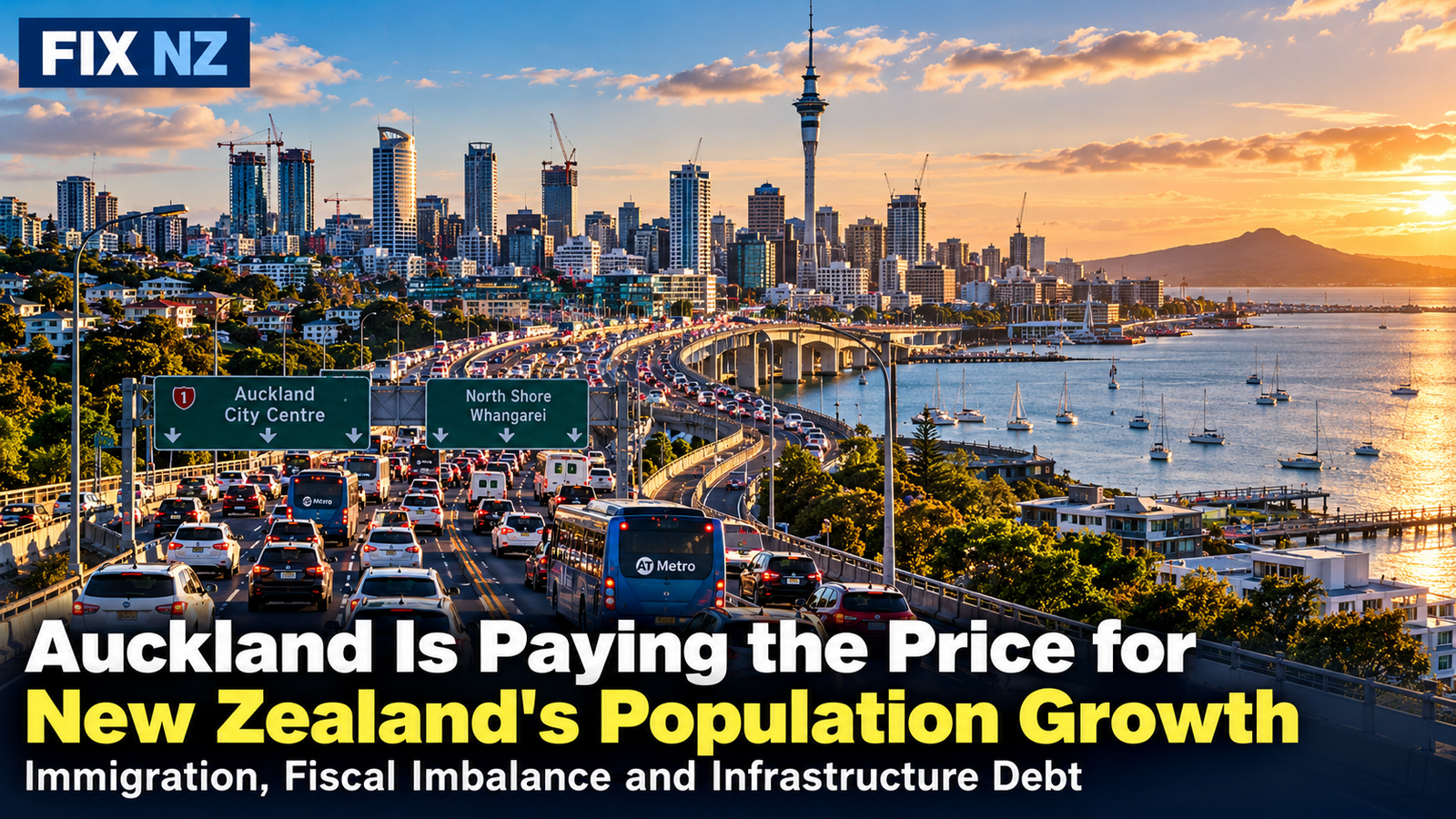
Auckland’s population pressure is not evenly distributed
New Zealand’s population debate often begins with national migration figures. Auckland’s problem is much more specific: a large share of newcomers settle where the jobs, businesses and international connections already are. Other regions attract fewer arrivals. Yet public investment does not necessarily adjust quickly enough to the different demands that result.
Imagine two regions with similar existing populations. One receives 100,000 additional temporary residents, the other does not. If infrastructure funding remains tied to outdated population figures or slow-moving budgets, the first region must serve many more people without a corresponding increase in capacity.
That is the core imbalance. Auckland carries the demand, while public funding may lag behind the people creating it. The precise size of that gap must be established through regional population and spending data; it should not be assumed that all government funding is distributed equally per head.
Temporary migrants are part of the real service population
A city’s infrastructure needs depend on how many people actually live in it and use its services, not simply how many hold permanent residence.
People on work and student visas use roads, public transport, housing and public spaces. Their access to publicly funded healthcare or education varies with eligibility, but their presence still creates real planning demands.
There is an important statistical distinction. New Zealand’s official estimated resident population already includes some long-term temporary migrants who meet residence criteria. The problem is therefore not that all migrants are excluded from official population counts. It is whether funding formulas, planning forecasts and project delivery fully and promptly reflect actual service populations, including shorter-term residents who generate measurable demand.
Public investment should follow the people actually using the infrastructure. A fast-changing city cannot afford a fiscal system that responds years after the population arrives.
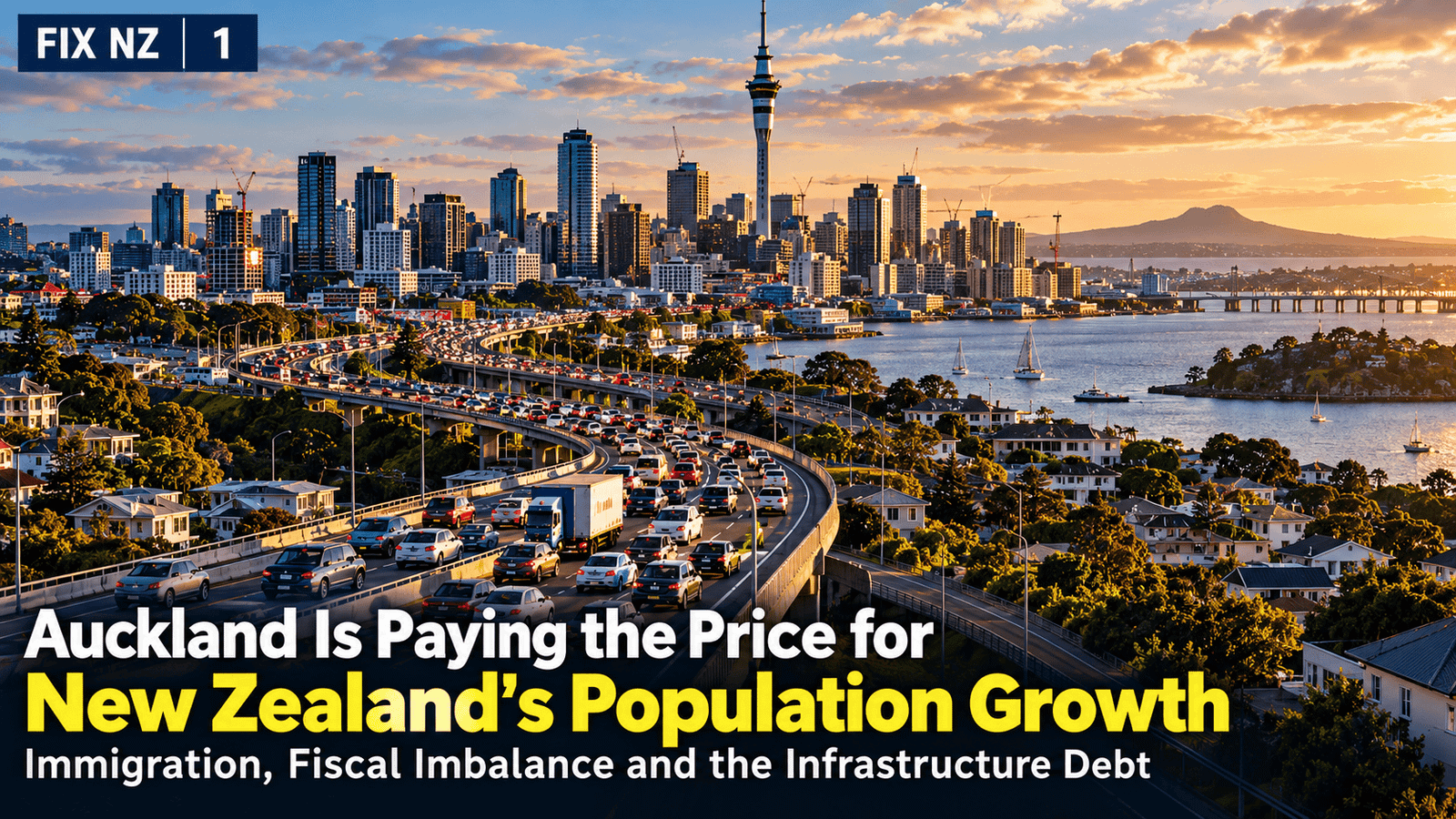
Traffic congestion is a cost imposed on residents
Auckland congestion is not an abstract urban-planning inconvenience. It is a bill paid every working day.
When roads and public transport fail to keep pace with development, residents pay through longer commutes, fuel costs and lost family time. Businesses pay through delivery delays and unpredictable journeys.
Consider an illustrative calculation: an extra 30 minutes of congestion across 230 working days costs one commuter 115 hours a year. Across 200,000 commuters, that would be 23 million hours. These are hypothetical inputs, not an estimate of Auckland’s measured congestion losses, but they show how quickly the burden accumulates.
Infrastructure that government does not build on time does not become free. Its cost is shifted onto the public.
Delayed investment also compounds the problem. Housing spreads farther from employment centres; travel distances grow; existing corridors become more crowded. A road or transit project delayed for years may cost more to build later, while residents have already paid years of congestion costs.
That is Auckland’s hidden infrastructure debt: not only unpaid construction bills, but time and productivity already lost.
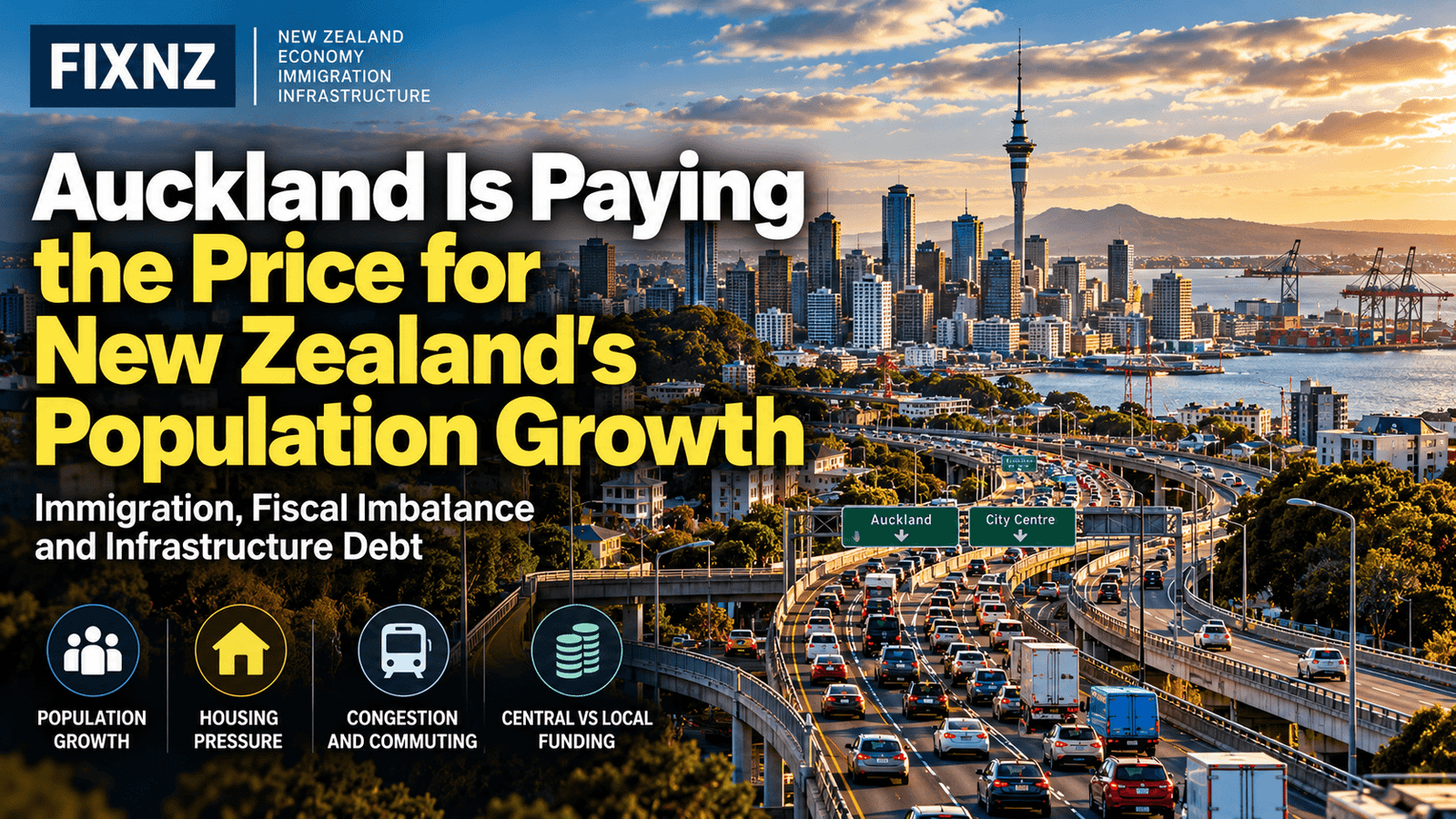
Healthcare and education accumulate the same debt
Roads are the most visible example, but healthcare and education require the same forward planning.
Additional residents can increase demand for primary care, hospital services, classrooms and local facilities. The impact depends on age, eligibility and existing capacity; it cannot be calculated from headcount alone. Yet schools and hospitals take years to plan, finance and expand.
If population growth arrives before capacity, the consequences can include longer journeys to services, crowded facilities and pressure on waiting times. A government can postpone capital expenditure; families cannot postpone every school day or medical need.
When the state permits population growth, it must plan and fund the infrastructure that growth requires. Approving additional demand now and leaving the investment to a future budget is a transfer of costs, not a saving.
Make public funding follow actual population pressure
The remedy is a funding model that responds to actual service populations and the pace of change.
First, measure how many people are genuinely living in each region, including temporary residents whose presence creates demonstrable service demand. Second, update those measures frequently enough to reflect rapid growth. Third, include existing infrastructure backlogs, so a city that has fallen behind receives catch-up investment rather than funding only for future arrivals. Fourth, account for project costs and the different needs of local populations.
This does not mean every government dollar should be divided mechanically by headcount. Remote communities can face higher per-person service costs; healthcare demand differs by age; some projects have national rather than local benefits.
But where population growth directly creates new infrastructure demand, the population being served and the speed of its growth must be explicit, auditable inputs to investment decisions.
Auckland is not asking for a special privilege. The principle is straightforward: funding should reflect the people and services the city is actually responsible for.
When capacity is exhausted, stop adding pressure
Better fiscal formulas cannot build a hospital, school or transport corridor overnight. Population policy must therefore respect physical capacity.
This article advocates a clear pause mechanism: when housing and essential infrastructure cannot accommodate further growth, the government should suspend additional population inflows that would deepen that capacity gap until projects catch up.
That does not mean removing people already lawfully living in New Zealand. Nor can the problem be solved by directing newcomers to another city without jobs, housing and services. Shifting the pressure elsewhere is not the same as solving it.
Infrastructure capacity must set the limit for additional population growth—not the other way around. Governments should not choose a growth target first and expect residents to absorb whatever costs follow.
Adopt a temporary net-zero population-growth target
The policy position of this editorial is explicit: until essential infrastructure catches up with demand, New Zealand should pursue a temporary net-zero population-growth target.
Net-zero total population growth is not identical to zero net migration. Births, deaths and international migration all affect the national total. A workable policy would require demographic forecasts, clearly defined review dates and migration settings calibrated to the target.
There are trade-offs. Some sectors could face labour shortages, and an ageing population would continue to create fiscal pressures. Training, productivity gains and more targeted skills policies would need to form part of the response.
But it is equally wrong to assume that every additional resident automatically delivers a net economic gain. More workers and consumers may generate revenue, while also requiring housing, transport, healthcare and education investment. The net outcome depends on those costs as well as the benefits.
If a government cannot deliver the infrastructure needed for further growth, continuing to increase demand risks expanding a social bill it has not funded. The proposed pause is therefore a deliberate policy choice: repair the existing deficit before pursuing a larger population.
Conclusion: pay down the infrastructure debt before growing again
Auckland’s congestion and pressure on public services are not solely caused by migration. Planning failures, construction constraints and historic underinvestment matter too. But population policy cannot be separated from the capacity of the places receiving new residents.
This editorial calls for three changes: make investment follow actual service populations, pause additional inflows when capacity is exhausted, and adopt a temporary national net-zero population-growth target while the infrastructure backlog is addressed.
Build the city first. Then decide how many more people it can support. Auckland residents should not keep paying with their time and quality of life for population growth that public investment has failed to accommodate.
Editorial note: This is a policy argument, not a claim that all New Zealand funding is allocated equally per person or that temporary migrants are absent from official population statistics. Quantifying the regional funding gap requires up-to-date migration, expenditure and infrastructure-capacity data.