
AI government efficiency should be a central issue in New Zealand’s 2026 election. FIXNZ believes political parties must explain how automation can reduce administrative waste, improve public services and strengthen citizen oversight.
FIXNZ Policy Position | New Zealand General Election 2026
New Zealand Needs More Than New Spending Promises
AI government efficiency is not simply about cutting costs. It means measuring public-service outcomes, reducing duplicated administration and making public spending easier to scrutinise.
New Zealand needs more than fresh fiscal promises. It needs modern government management. At every election, parties debate how much to spend on health, education, housing, transport and welfare, which taxes to cut, and what new programmes to introduce. FIXNZ asks a more fundamental question: How will you improve the efficiency of government itself? How will you measure public spending, find duplicated administration, ensure budgets reach those who need them, and use AI, computing and automation to deliver better public services at lower administrative cost? Above all, will you establish a dedicated government AI automation and efficiency reform body, while opening appropriate data and enquiry channels for public oversight? Modernisation must serve two goals together: efficient administration and citizens’ ability to scrutinise government.
1. AI Government Efficiency: Make Automation an Explicit Reform Commitment
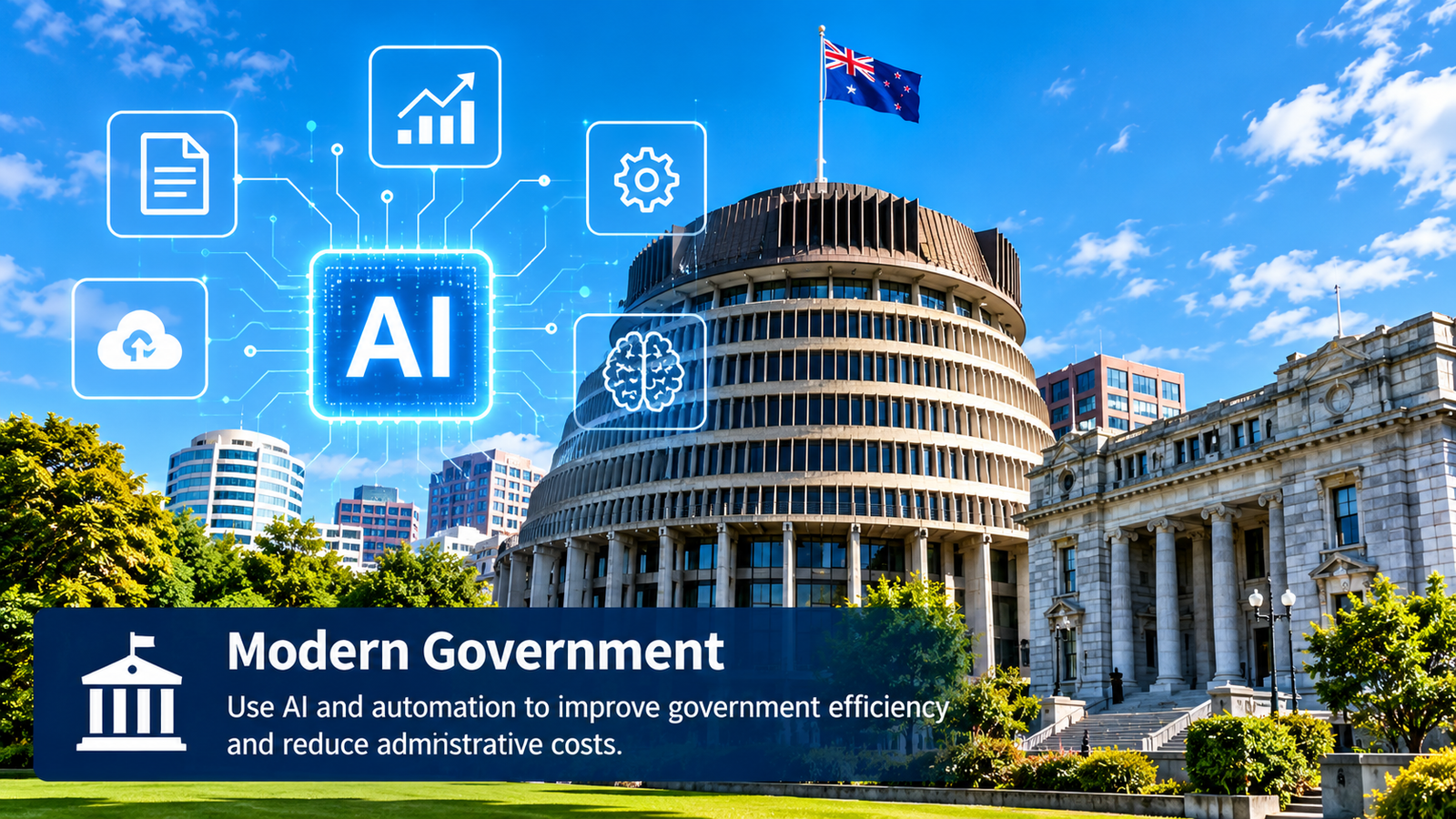
Modern AI and automation can assist with repetitive tasks: checking documents, organising records, compiling statistics, tracking workflows, producing reports and identifying anomalies. Such work has often involved repeated manual handling and transfers between departments. FIXNZ proposes legislation establishing a national government AI automation and administrative efficiency agency, tasked with common data standards, interoperable departmental systems, process reform and public-spending monitoring. Its statutory powers, access to data and independent oversight must be clear. It must not become merely another advisory management layer.
Reform should not begin with an arbitrary civil-service headcount reduction. Health care, nursing, education, public safety and other essential frontline services still require adequate staffing. Priority should go to duplicate data entry, repeated approvals, overlapping functions, excessive management steps and administrative work that can be automated. Affected workers need training, redeployment and lawful employment arrangements. The purpose is not to burden frontline staff, but to reduce unnecessary administration and make management support public services.
2. In Difficult Economic Times, Every Dollar Must Be Accounted for
New Zealand faces fiscal constraints and economic pressure. Spending cannot grow without limit, and taxes or borrowing alone cannot solve every problem. Government expenditure information is dispersed across departments, annual reports, budgets and procurement systems. Even published information can be difficult for the public to find, compare and understand.
FIXNZ proposes a unified public-finance data system, using AI and automation to continually analyse spending and results. It should compare budgets with actual expenditure, costs across similar projects, historical averages, project progress, contract variations and public-service outcomes. An unusually expensive road project could trigger a review; rising departmental administration costs without better processing performance should demand an explanation. Equally, a spending reduction that worsens hospital waiting times or service quality should raise an alert.
Saving money does not necessarily mean greater efficiency, and spending more does not necessarily mean better services. Inputs, costs and outcomes must be assessed together. AI can help model alternative resource allocations against population needs, regional differences and service gaps. Fairness means decisions follow reasonable rules and real needs—not that every area receives identical amounts.
3. A Citizens’ AI Oversight Platform
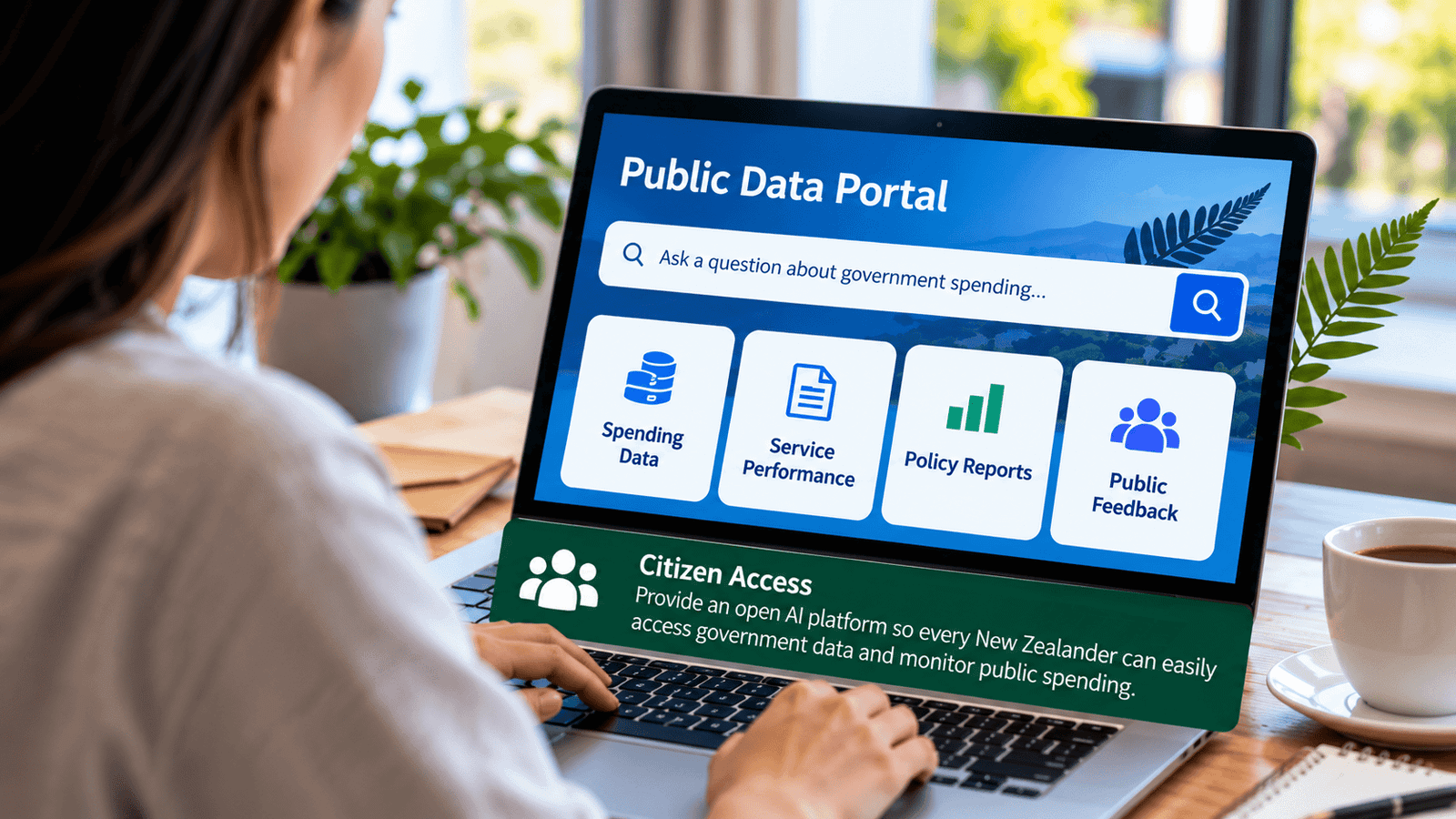
Government must not build AI systems only for itself. It must also provide public tools for enquiry and oversight. Today, understanding a public project or election promise can mean navigating complex reports, contacting agencies or making formal information requests. A unified public AI enquiry platform could let people ask in natural language: How much road-maintenance funding did our area receive this year? What was this project’s original budget and actual cost? Why is it two years late? How much extra service did a health policy promise, and how much has been delivered?
Answers should draw on lawfully public records and show original sources, calculations and update dates. Ordinary public-finance information should not require cumbersome approval.
Public access: Anyone can consult public budgets, disclosable contracts, policy implementation progress, statistics and performance reports. Citizen accounts: People can save projects, subscribe to anomaly alerts, raise questions or complaints and track responses. Accounts may use proportionate identity verification, but public fiscal information should not arbitrarily require a real-name login. Personal privacy, legally protected commercial material and other restricted information must remain protected. The focus is public money and official performance, not access to private records.
Let AI and Citizens Identify Problems Together
People should be able to flag unusually expensive contracts, apparent gaps between official claims and local services, or unexplained budget variances, with supporting evidence. Each complaint needs a reference number, status, response deadline and record of the government’s reply. Where disclosure is lawful, the outcome and corrective action should be visible. Oversight must go beyond accepting complaints: people must know whether concerns were addressed and problems corrected.
4. Detect Waste, Fraud and Potential Corruption
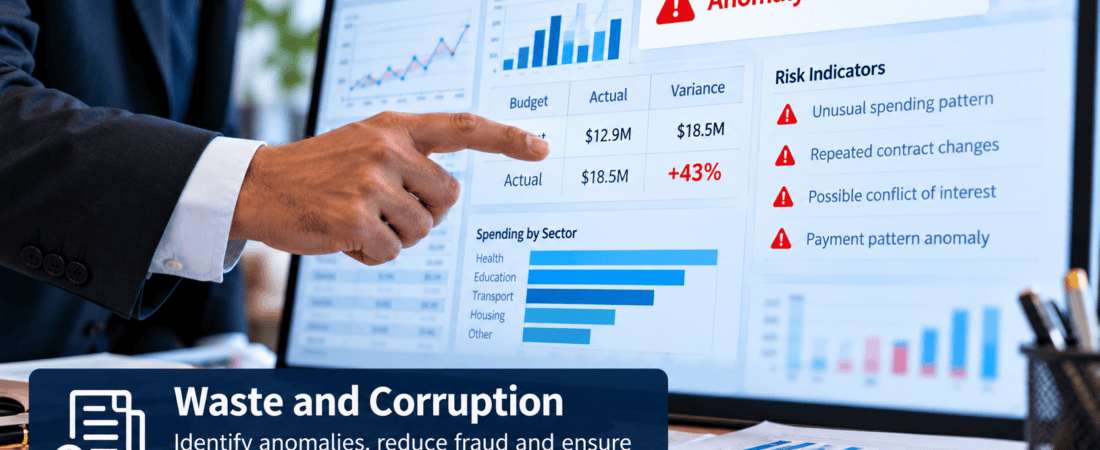
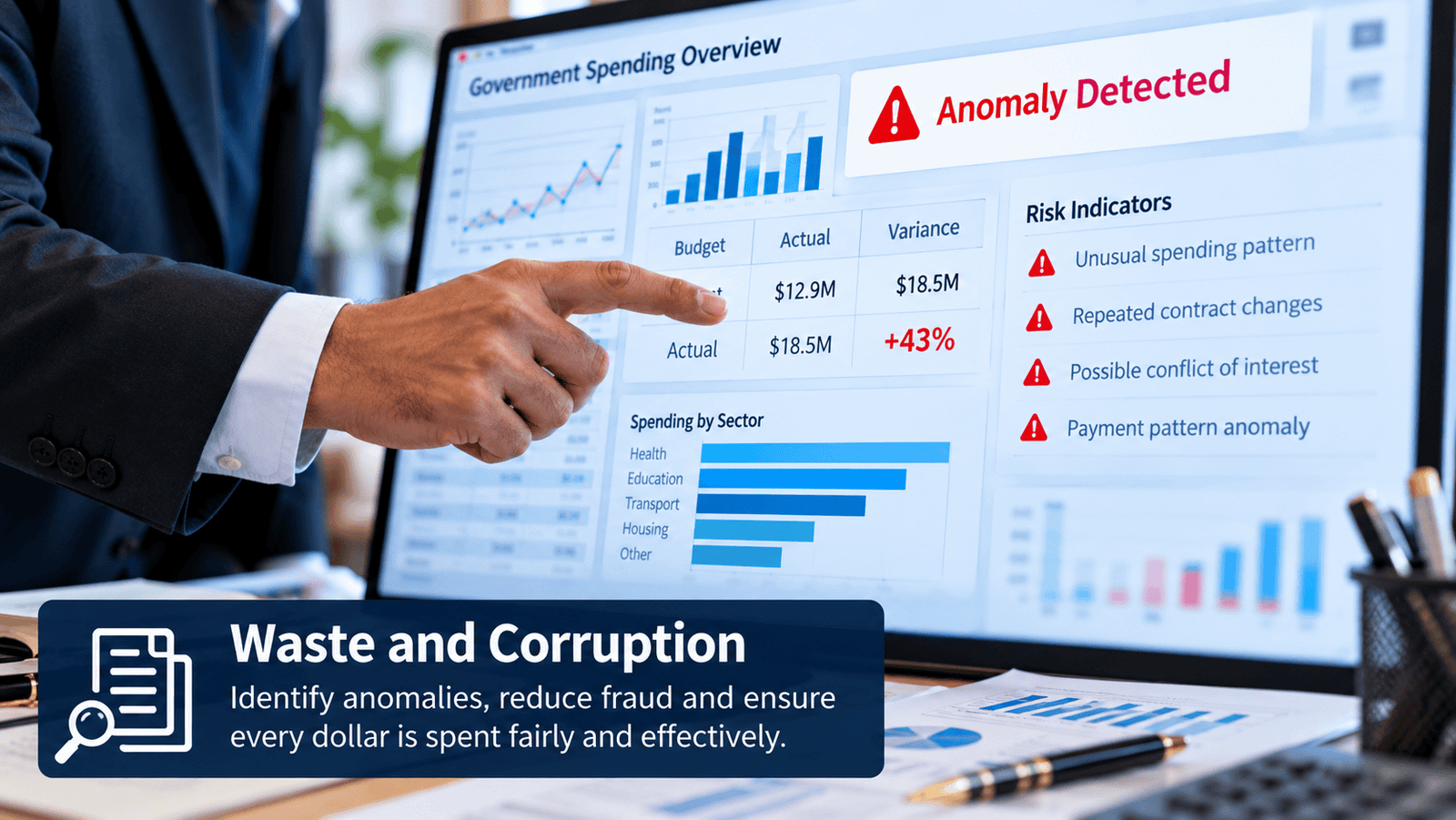
Public procurement, construction, welfare payments and administration generate extensive data. AI can flag unusual bids, duplicate payments, frequent contract changes, unexplained delays and applications requiring further checks. Automation can extend the reach of screening while leaving specialist investigators to examine higher-risk cases.
Where unlawful conduct or improper influence is suspected, investigators should have legally defined access to necessary evidence, potentially including relevant financial transactions and conflicts of interest under explicit statutory conditions. Powers must be constrained by law, access logs, independent oversight and remedies for error. Privacy should not be an absolute barrier to lawful investigation; nor should anti-corruption become an excuse for unlimited personal-data collection.
An anomaly is not proof of misconduct. Suspected illegality is not a finding of guilt. AI should identify leads and assist analysis; legally authorised bodies remain responsible for investigations and legal decisions.
5. Remove Duplicated Management, Not Just Rename Departments
Merging departments does not necessarily save money if duplicate management, approval processes and IT systems survive. Government should examine workloads, approval times, staffing, management costs and service outcomes across agencies.
Citizens should not repeatedly supply information government can lawfully share. Documents that can be checked automatically should not travel through multiple offices. Common statistics should not be calculated separately by different teams. AI can also reveal uneven workloads, support better resource allocation and free frontline staff from repetitive paperwork.
Success must be measured by verified net savings, processing speed, error rates, public satisfaction and service quality—not organisational charts alone.

6. Seven Questions on AI Government Efficiency Every Election Party Should Answer
FIXNZ asks every party contesting the election to publish clear answers:
- Will you establish a government AI automation and efficiency reform body with statutory responsibilities?
- Will you publish a plan for data standards, cross-agency collaboration and automated administrative workflows?
- Will you create a citizens’ AI enquiry and oversight platform for public finances and policy delivery?
- What measurable targets and deadlines will you set for reducing duplicate management costs and improving efficiency?
- What investment is required, what net savings do you forecast, and how are those figures calculated?
- How will you protect essential frontline services and support staff transitions?
- How will you provide independent audits, anomaly alerts, public complaints and transparent corrective action?
Parties need not choose identical technologies. Those opposed to a dedicated agency or a particular automation model should propose credible alternatives that achieve similarly verifiable efficiency and transparency. Promises must be implementable, measurable and open to public scrutiny.
Conclusion: Government Progress Takes More Than Attractive Promises
For historical fiscal context, read FIXNZ’s 36-year review of New Zealand government spending and accountability. Public-service workforce trends can also be checked against the New Zealand Public Service Commission’s long-term workforce data.
AI and automation are not universal solutions, and cannot replace democracy, legal safeguards or professional judgment. They can, however, help reduce repetitive work, improve resource allocation, monitor spending and identify potential problems.
FIXNZ believes parties must explain how they will modernise government, not merely how much they will spend or which taxes they will cut. Technology should help citizens see where public money goes, whether policies are delivered and how officials respond to challenges.
FIXNZ’s position is clear: government AI automation, administrative efficiency and public data oversight must be serious election issues. If a party refuses to engage and offers no credible alternative, voters have reason to question its capacity to improve governance. Parties willing to publish technical plans, cost estimates, performance audits and public oversight mechanisms can be compared on substance.
New Zealand needs a government that does more than spend money: it must account for that money, deliver effectively and answer to its citizens.