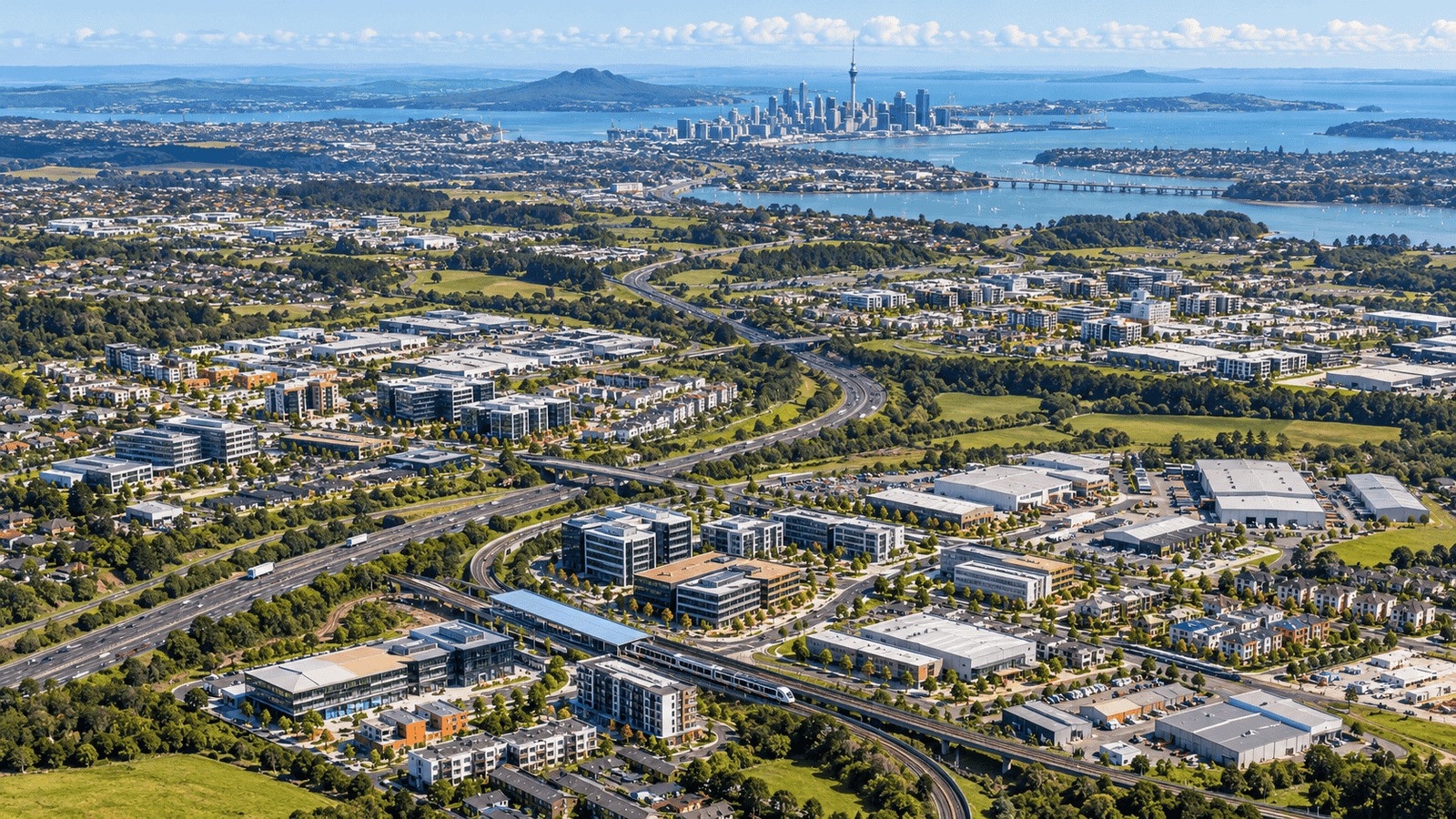
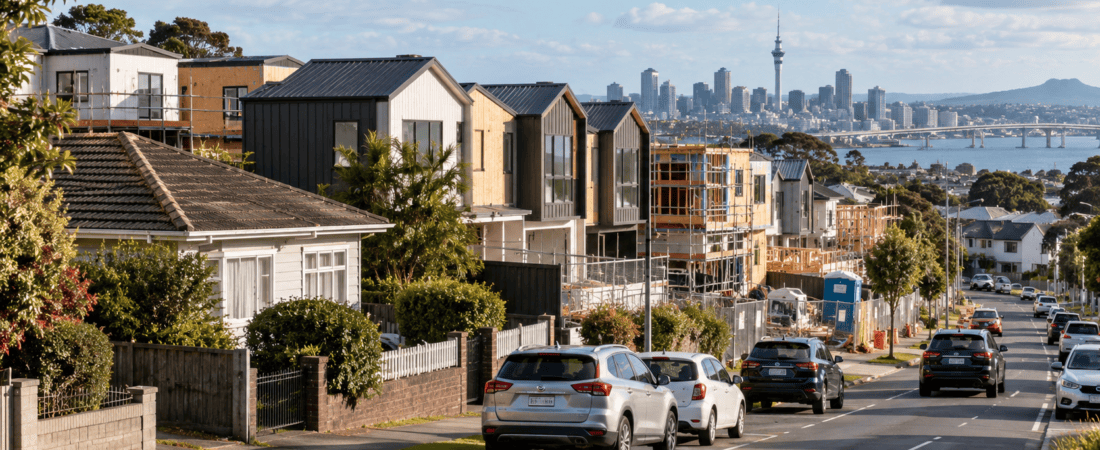
Housing density is rising. Infrastructure and employment must grow with it.
Auckland housing and jobs must grow together. Building more homes without creating nearby employment increases commuting pressure and infrastructure costs.
Auckland is already New Zealand’s dominant population and economic centre. For years, the response to housing pressure has focused heavily on one question: how can we fit more homes into the existing city?
That response is now visible across Auckland.
A single suburban house is demolished. Three, four or sometimes more townhouses appear on the same site. Streets that were designed for low-density suburbs are steadily carrying more households, more cars, more deliveries, more school trips and more demand for public services.
The data confirms that this is not just an impression. In the year to July 2026, Auckland consented 17,260 new dwellings. In July alone, 53% of new dwellings were townhouses, flats, units, retirement-village units or other attached housing, while only 44% were stand-alone houses. Over the preceding 12 months, 95% of new dwelling consents were inside Auckland’s Rural Urban Boundary.
That means much of Auckland’s growth is being absorbed inside the existing urban footprint.
There is nothing inherently wrong with higher-density housing. It can lower the amount of land required per household, make some homes more affordable and support better public transport.
The problem begins when housing density increases faster than employment, transport, schools, healthcare and local infrastructure.
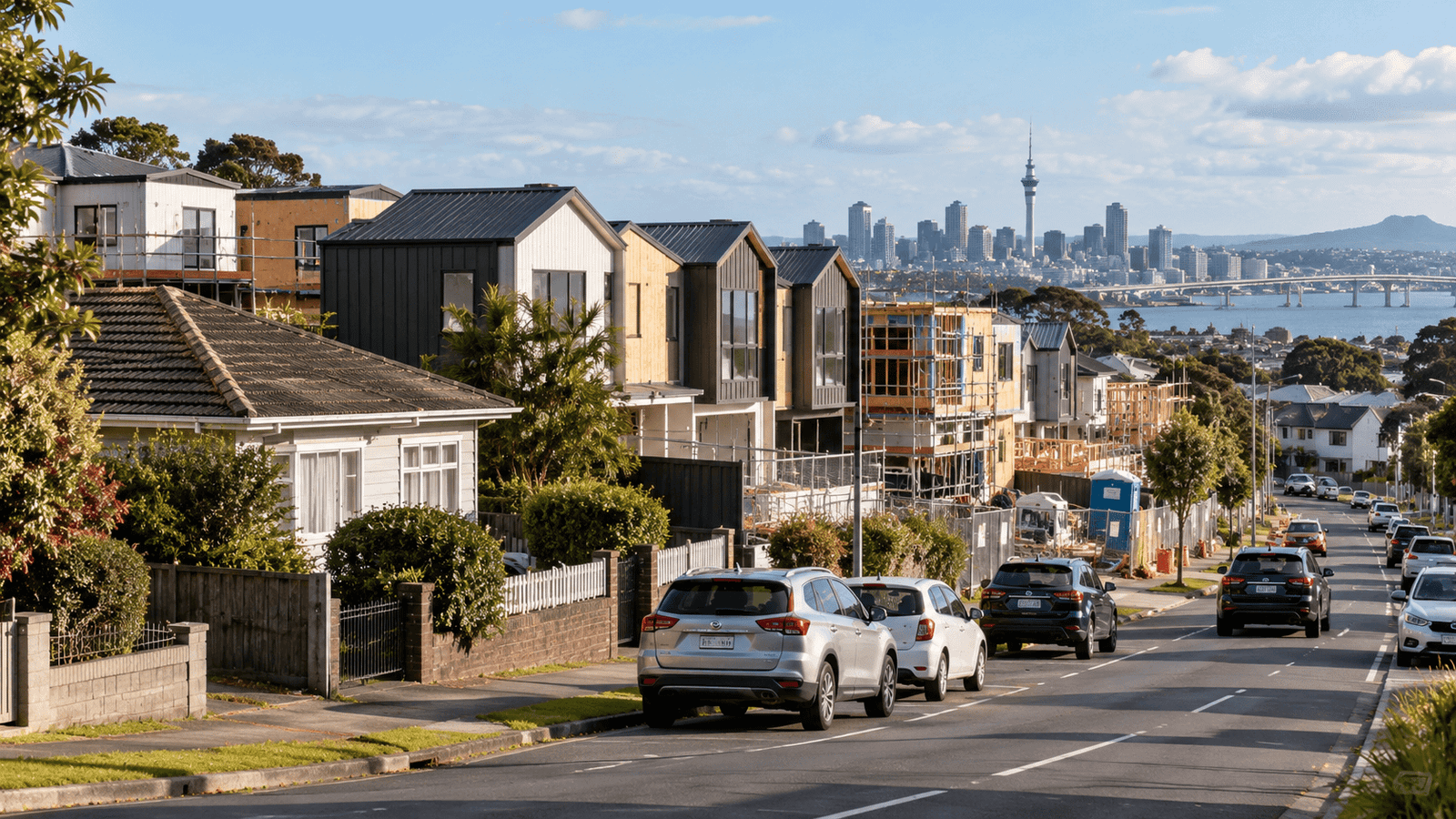
Auckland is adding residents faster than it is redistributing jobs
Auckland’s growth is not occurring in a vacuum. Migration continues to add new residents, while New Zealanders also move between regions and overseas. Housing demand therefore changes not only in quantity, but in location and household type.
Auckland housing and jobs are becoming increasingly disconnected as residential growth spreads faster than employment opportunities across the region.
The danger is that Auckland continues to decentralise housing while leaving too much employment concentrated in traditional commercial and industrial areas.
A household may now be able to find a townhouse in Albany, Silverdale, Westgate, Drury or another growth area. But if the job remains in the city centre, Penrose, East Tāmaki, the airport corridor or another distant employment zone, the new housing has not removed transport demand.
It has simply moved the starting point of the commute.
This matters because Auckland already carries a substantial congestion burden. Auckland Transport says peak congestion costs the region heavily and estimates commuters lose an average of 66 hours a year in peak-period congestion.
Current network data does not show that every Auckland journey is already getting dramatically longer: AT reported a rolling 12-month average of about 22.9 minutes for a representative 10 km arterial trip at the end of 2025. But that stability should not be mistaken for spare capacity. Auckland already operates with significant congestion, and growth without matching infrastructure or job decentralisation increases the risk that journey times and reliability deteriorate.
Auckland housing and jobs are growing in different places
This is where Auckland’s next planning problem begins.
A city cannot simply approve more residential capacity and assume everything else will adjust later.
Every additional community also requires roads and intersections, public transport, schools, childcare, GP capacity, water and wastewater infrastructure, local retail, logistics, workshops, offices and industrial employment.
Auckland’s own Future Development Strategy acknowledges that industrial land is already constrained. It describes high demand, historically low industrial vacancy rates, few undeveloped sites in older industrial areas and upward pressure on rents. It also recognises that some land-intensive industries may need new greenfield business land.
This is crucial.
If housing land expands while industrial and commercial land remains scarce and expensive, Auckland creates a structural imbalance:
People move outward, but jobs do not move outward with them.
The result is more cross-city travel.
For North Auckland and Rodney, that can mean additional pressure toward Albany, the Upper Harbour corridor, SH1 and eventually the Harbour Bridge.
For northwest Auckland, it can mean increasing pressure around SH16 and SH18.
For southern growth areas, it can mean more traffic moving toward established industrial and employment areas rather than being absorbed locally.
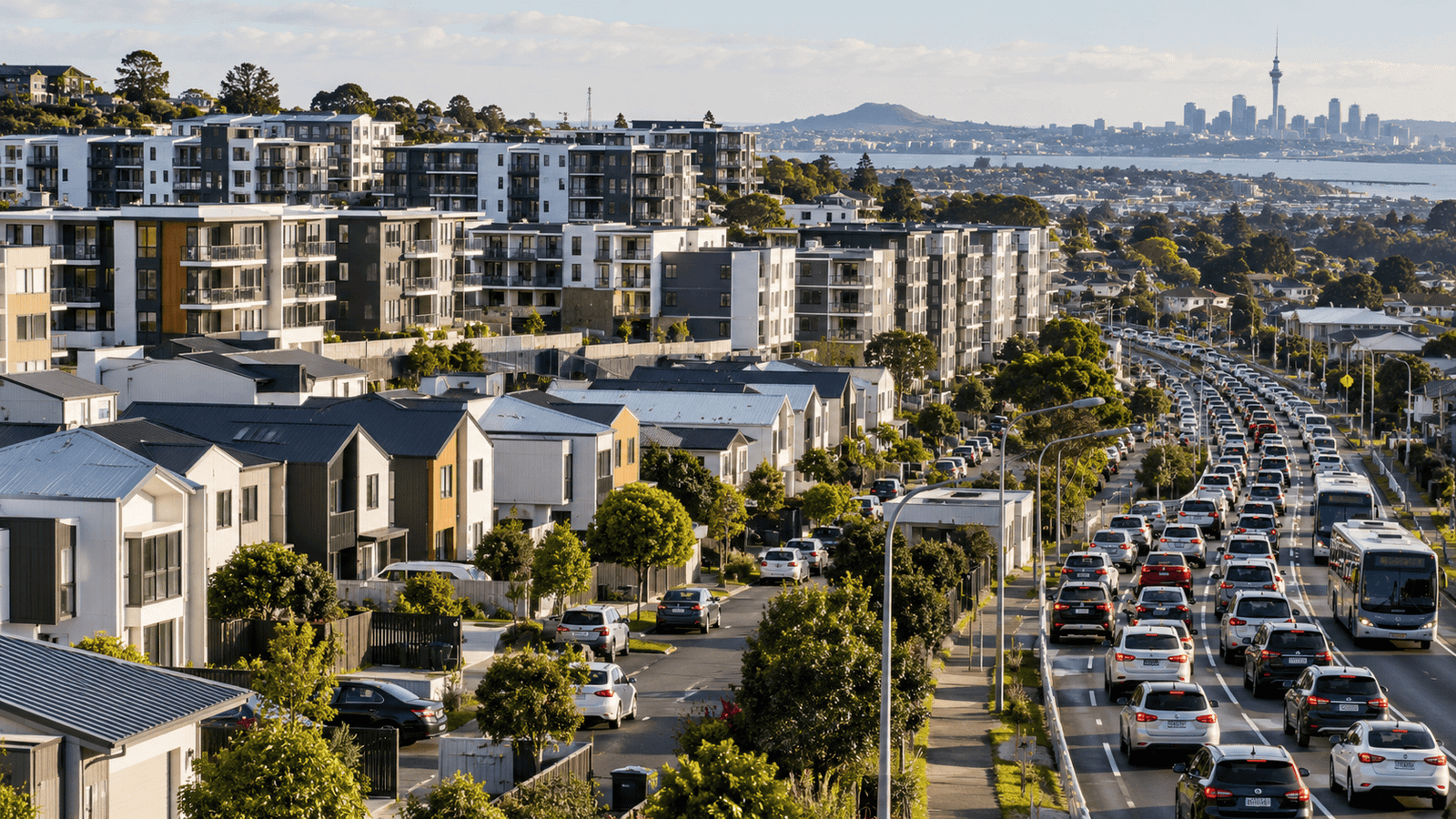
Auckland needs more than new suburbs. It needs new employment centres.
FIXNZ proposes a different approach.
Auckland should deliberately accelerate the creation of multiple major employment centres around the metropolitan edge, rather than continuing to concentrate economic activity in a relatively small number of established locations.
This does not mean abandoning the CBD. The city centre will remain important.
It means building a genuinely polycentric Auckland.
In the north, the Albany–Rosedale area can continue developing, but future growth should extend toward Silverdale, Dairy Flat and Rodney with substantially more land reserved for commercial, technology, light-industrial, logistics, medical and professional employment.
In the northwest, Westgate and Whenuapai can become a stronger employment and industrial centre rather than primarily another residential expansion area.
In the south, future growth around Drury, Puhinui and the wider southern corridor should similarly include major employment capacity alongside housing.
Auckland’s existing strategy already moves partly in this direction. Council planning has brought forward around 250 hectares of business land at Whenuapai and identifies future business land at Silverdale and Puhinui. The Future Development Strategy also models substantial employment growth in new centres such as Drury, Red Hills and Whenuapai.
The question is whether Auckland is moving fast enough.
Do not sell the land. Keep it public and lease it for productive use.
Simply zoning additional commercial and industrial land may not be enough.
If newly released land immediately trades at ordinary speculative market prices, part of the benefit can be absorbed into land values before productive businesses ever arrive.
FIXNZ therefore proposes considering a public industrial and commercial land reserve.
The government or council would retain ownership of selected strategic land.
Instead of selling it, the land could be offered through long-term leases at favourable initial rates to qualifying businesses willing to establish real operations and employment in designated growth centres.
Conditions could include minimum employment, construction deadlines, restrictions on speculative subleasing, clawback provisions and requirements that the land remain in productive commercial or industrial use.
The objective would not be to subsidise land speculation.
It would be to make it economically realistic for manufacturers, logistics firms, technology companies, workshops, medical facilities and other employers to establish themselves close to new population centres.
If the public retains ownership, future generations also retain control of strategically important employment land.
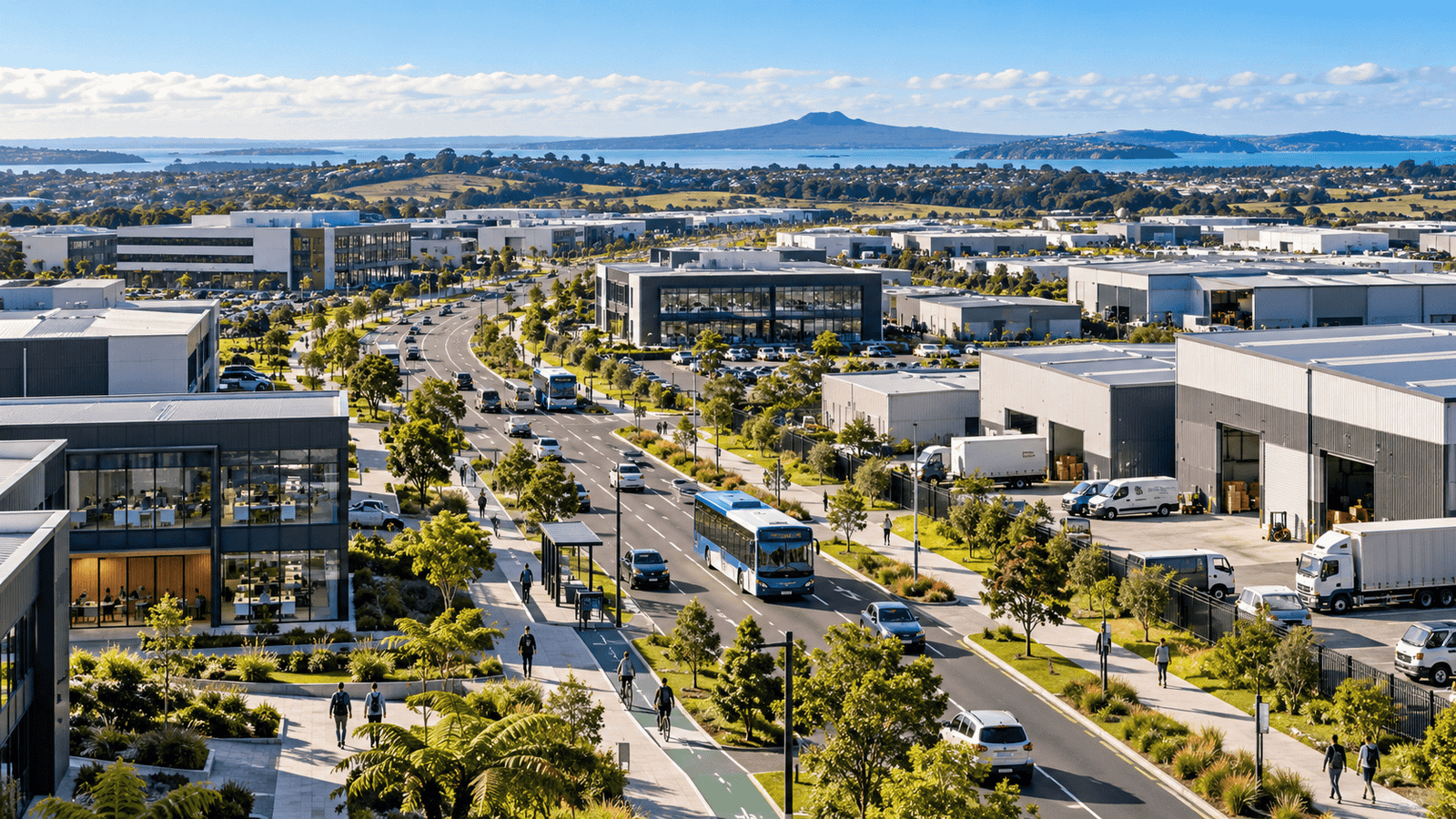
The cheapest commute is the commute that never has to cross the city
Transport investment will remain essential. Auckland still needs better roads, public transport, bus priority, rail capacity and local street upgrades.
But infrastructure alone cannot solve a land-use problem.
A worker who lives in Rodney but works near home does not need another lane across the Harbour Bridge.
A West Auckland resident employed at Westgate or Whenuapai does not need to travel across the entire city each morning.
A family living near Drury whose jobs, school, GP and shopping are all nearby generates a completely different transport pattern from a household that must travel 30 kilometres for most daily needs.
That is the central principle:
Auckland cannot keep decentralising housing while centralising employment.
Growth should improve living standards, not slowly erode them
Population growth can be economically valuable. More residents mean more workers, consumers, businesses, skills and economic activity.
But population growth is not automatically an improvement in living standards.
If additional population produces longer journeys, overcrowded schools, harder access to primary healthcare, inadequate parking, overloaded local roads and more expensive industrial land, then some of the economic gain is being offset by declining everyday quality of life.
The correct response is not to stop Auckland growing.
It is to make growth spatially balanced.
New housing should be accompanied by new employment land.
New employment centres should be accompanied by transport and public services.
And strategic industrial land should be protected before housing and higher-value speculative uses make it impossible to recover.
Auckland has already learned how to increase housing capacity.
Its next challenge is harder:
Can it increase economic and infrastructure capacity at the same speed?
If not, the city may solve one housing problem only to create a much larger accessibility problem.
If it can, Auckland could evolve from an increasingly congested single-centre metropolis into a stronger network of connected regional centres — north, northwest, south and central — where more people can live, work and access essential services without crossing half the city every day.
Auckland Is Paying the Price for New Zealand’s Population Growth