

New Zealand Election Warning: Welfare, Immigration and the Risk of Building Political Vote Banks
As New Zealand approaches another election cycle, immigration and social welfare should be debated as national policy — not treated as tools for building long-term electoral advantage.
New Zealand is an immigrant nation. New migrants contribute skills, investment, entrepreneurship, taxes, cultural diversity and new connections to the world. They should be welcomed as future members of New Zealand society, not viewed simply as political supporters waiting to be recruited.
At the same time, New Zealanders have a legitimate reason to ask a difficult question:
Could political parties be tempted to combine immigration policy and access to public benefits in ways that help create future electoral constituencies?
This question should not be directed against immigrants. It should be directed at the political system.
The problem is incentives, not ethnicity
Democratic politics naturally encourages parties to win votes. That is normal.
The danger begins when governments or political parties have incentives to use taxpayer-funded resources to strengthen particular electoral constituencies.
Social welfare exists to protect people from hardship, disability, unemployment, housing insecurity and other genuine needs. Immigration policy exists to serve New Zealand's economic, humanitarian, family and long-term national interests.
Neither system should become an electoral recruitment mechanism.
If immigration settings, residency pathways, eligibility rules or publicly funded benefits are changed close to elections, the public should be able to examine the reasons, costs and expected outcomes.
The same principle must apply regardless of which political party is in government.
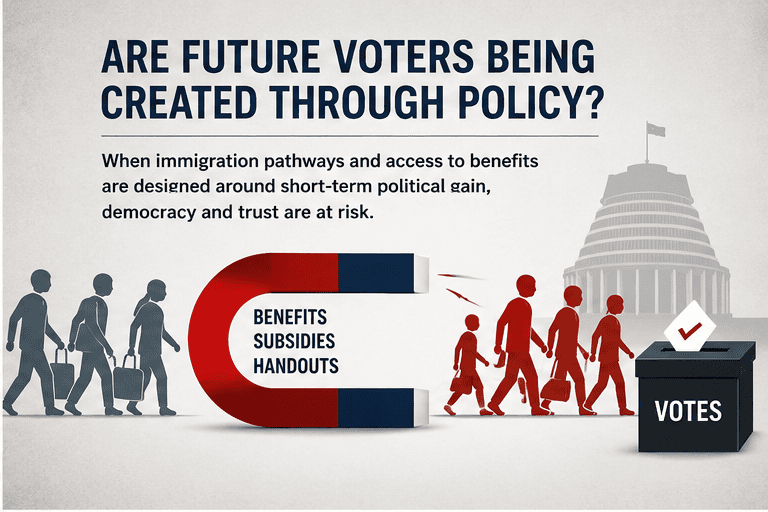
Welfare belongs to the public
A government does not own welfare money.
A political party does not own welfare money.
It comes from taxpayers and from the collective resources of New Zealand society.
That creates an important democratic principle:
A political party should never be able to gain an electoral advantage simply by distributing public resources more generously to groups it expects will later support it.
This principle should apply to everyone — migrants and New Zealand-born citizens alike.
A government increasing benefits for pensioners immediately before an election deserves scrutiny. So does targeted assistance for families, businesses, homeowners, particular industries or newly arrived communities.
The issue is not who receives assistance.
The issue is whether public money is being allocated according to transparent public-interest criteria rather than electoral calculations.
Immigration deserves the same protection
Immigration policy is especially vulnerable because today's immigration decisions can influence tomorrow's population, labour market, housing demand, infrastructure requirements and electorate.
That does not mean immigrants vote as a bloc. They clearly do not. Migrants come from different countries, economic backgrounds, religions and political traditions and hold widely different political opinions.
Treating them as a single voting group would itself be misleading.
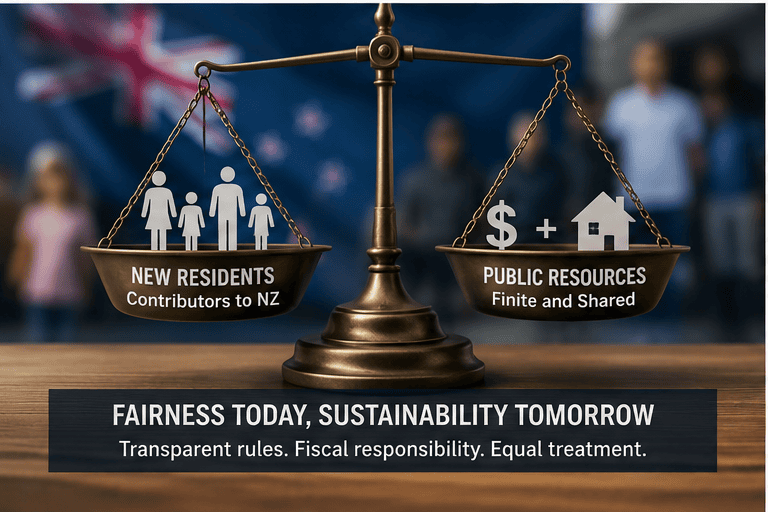
But that is precisely why political parties should resist attempts to cultivate migrant communities primarily as electoral constituencies.
New residents should be encouraged to become independent participants in New Zealand democracy — capable of supporting Labour, National, ACT, the Greens, New Zealand First, Te Pāti Māori, another party, or no party at all.
Citizenship should create citizens, not political clients.
Election-year transparency
FIXNZ believes New Zealand could introduce stronger safeguards around major immigration and welfare policy changes during election periods.
For example, significant changes announced close to an election could be accompanied by an independent public assessment showing:
the expected fiscal cost; who qualifies and why; expected immigration or population effects; housing and infrastructure implications; labour-market impacts; whether the policy is temporary or permanent; and whether equivalent assistance is available according to consistent criteria.
Parliament should also consider requiring clearer long-term fiscal modelling when immigration policy and welfare eligibility interact.
The objective is not to prevent governments from helping people.
It is to make governments explain why they are helping, how much it costs, who ultimately pays and whether the policy serves the national interest.
Do not blame migrants
This distinction matters.
If political incentives within New Zealand's immigration or welfare system are poorly designed, that is New Zealand's institutional problem — not the fault of immigrants who lawfully use the system available to them.
A migrant family following the rules should not be blamed for receiving an entitlement Parliament deliberately created.
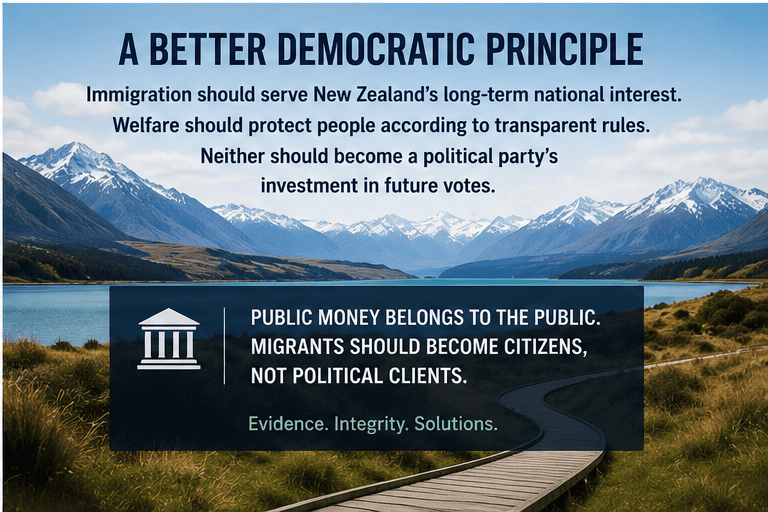
Accountability belongs primarily with the people designing those rules.
Public debate therefore needs to avoid turning legitimate scrutiny of government policy into hostility toward migrants.
New Zealand can simultaneously be:
pro-immigration, pro-fairness, pro-welfare safety net and strongly opposed to political patronage.
Those positions are not contradictory.
A better democratic principle
FIXNZ proposes a simple standard:
Immigration should serve New Zealand's long-term national interest. Welfare should protect people according to transparent rules. Neither should become a political party's investment in future votes.
Before every election, New Zealanders should scrutinise promises involving immigration, residency, citizenship and public benefits with the same question:
Would this still be good public policy if the people receiving the benefit never voted for the party proposing it?
If the answer is yes, there is probably a strong policy case.
If the answer becomes uncomfortable, the policy deserves much closer examination.
Core claim
Migrants should become independent New Zealand citizens and residents — not anyone's political vote bank. Public welfare belongs to the public, not to political parties.