

Good Institutions Need More Than Good Intentions
Good government cannot depend entirely on good people.
Capable and well-intentioned decision-makers can still make poor choices. They operate under pressure, incomplete information, political incentives, organisational habits and limited time.
That is why strong institutions matter.
A durable system should not assume that every person with authority will always make the right decision.
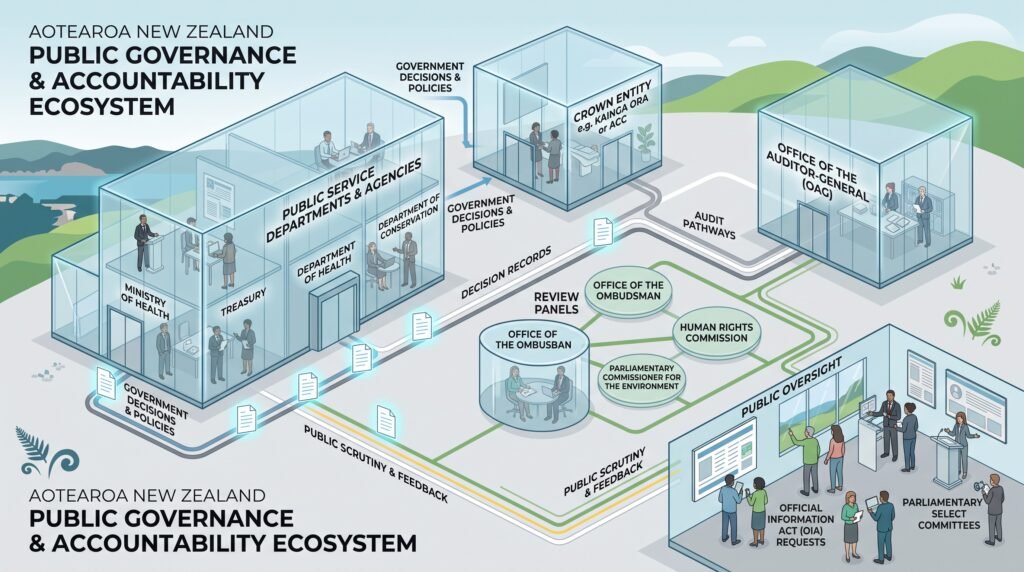
It should make important decisions visible, reviewable and difficult to abuse.
This is one of the central questions behind New Zealand governance reform.
Explore supporting evidence and public reports in the Data & Truth library.
Institutions Matter Because People Are Imperfect
Governance systems are sometimes designed as if the quality of government depends mainly on choosing the right leaders.
Leadership matters.
But no appointment, election or recruitment process can guarantee perfect judgement.
Institutions exist partly because human judgement has limits.
Good institutional design can provide:
- clear decision-making authority
- written records
- independent review
- conflict-of-interest rules
- audit mechanisms
- appeal processes
- public reporting
These mechanisms do not eliminate mistakes.
They make mistakes easier to detect, examine and correct.
Transparency Is More Than Publishing Documents
Transparency is often treated as a moral principle.
It is also a practical management tool.
When decision-makers know that assumptions, spending and outcomes may later be examined, they have stronger incentives to document their reasoning.
Good transparency should help answer:
Who made the decision?
What information was available?
What alternatives were considered?
What did the decision cost?
What happened afterward?
Publishing thousands of pages without structure is not necessarily transparency.
Information must also be understandable and accessible.
Responsibility Should Follow Authority
One of the hardest governance problems appears when authority and responsibility become separated.
An individual or agency may have the power to approve a major decision while the consequences are spread across taxpayers, future governments or other institutions.
When responsibility is unclear, failure can become difficult to attribute.
This does not mean every unsuccessful public decision requires punishment.
Governments must sometimes take risks.
Not every project will succeed.
But there should be a clear distinction between:
- reasonable decisions that produce disappointing outcomes; and
- poor processes, ignored warnings or failures of oversight.
Accountability should focus on the quality of decision-making, not merely whether the final result was popular.
Independent Oversight Protects Everyone
Oversight bodies are sometimes viewed as obstacles to government action.
Poorly designed oversight can certainly create delay and unnecessary bureaucracy.
But independent review also protects:
- taxpayers
- public servants
- ministers
- agencies
- future governments
A credible independent review process can establish whether procedures were followed and whether accusations are supported by evidence.
That protects officials from unfair allegations just as much as it protects the public from misconduct.
Oversight Should Not Become Paralysis
More oversight is not automatically better governance.
Every additional approval layer creates time and cost.
If every routine decision requires multiple reviews, institutions can become slow, defensive and unwilling to innovate.
The objective should therefore be proportionality.
High-risk decisions deserve stronger scrutiny.
Routine decisions should remain efficient.
Governance reform should ask:
How much oversight is appropriate for the scale of the risk?
Public Loss Requires Clearer Evaluation
Governments routinely manage projects involving uncertainty.
Infrastructure, technology systems, procurement programmes and policy reforms can all fail.
A failed project is not automatically evidence of misconduct.
The relevant questions are more precise:
- Was the original decision reasonable?
- Were risks identified?
- Was independent advice considered?
- Were warning signs ignored?
- Did decision-makers have conflicts of interest?
- Were corrective actions taken when problems emerged?
A system that treats every loss as wrongdoing discourages responsible risk-taking.
A system that treats every loss as nobody’s responsibility encourages poor decision-making.
Good governance requires a middle ground.
Records Create Institutional Memory
Public organisations frequently change staff, ministers and leadership.
Without reliable records, institutional knowledge disappears.
This creates repeated mistakes.
Good recordkeeping allows future decision-makers to understand:
- why a policy was adopted
- what assumptions were made
- what risks were identified
- what worked
- what failed
Records are therefore not merely administrative paperwork.
They are part of institutional memory.
Technology Creates New Governance Questions
Public institutions increasingly rely on data, algorithms and automated systems.
These tools can improve efficiency.
They can also make decisions harder to understand.
If an automated system influences policing, benefit eligibility, regulatory enforcement or public-service decisions, governance must address:
- who designed the system
- what data it uses
- how errors can be challenged
- whether bias is monitored
- who remains accountable
Technology should not create a gap where responsibility disappears behind software.
What Should Better Governance Reform Ask?
A stronger institutional framework should begin with a few basic questions.
1. Who has authority?
Responsibility should be connected clearly to decision-making power.
2. What evidence was used?
Important decisions should leave an understandable record.
3. Who can independently review the decision?
Oversight should be credible and appropriately independent.
4. What happens when something goes wrong?
There should be mechanisms for correction, investigation and learning.
5. Are safeguards proportionate?
Oversight should protect the public without making ordinary government impossible.
6. Can the public understand the process?
Transparency should produce useful information, not simply more documents.
Explore possible institutional reforms in the FIXNZ Solution Lab.
The FIXNZ Perspective
Strong institutions are not designed for perfect leaders.
They are designed for ordinary people operating under imperfect conditions.
A good governance system should make power usable but accountable.
It should allow governments to act while preserving independent review.
It should distinguish between reasonable failure and irresponsible decision-making.
And it should create records that allow future governments and the public to learn from the past.
The purpose of governance reform is not to eliminate discretion.
It is to ensure that discretion operates within institutions capable of explaining, reviewing and correcting the exercise of public power.
Explore the full Governance analysis on FIXNZ.