
Why Housing Costs Keep Rising Even When We Build More
Housing supply matters.
But building more homes does not automatically make housing affordable.
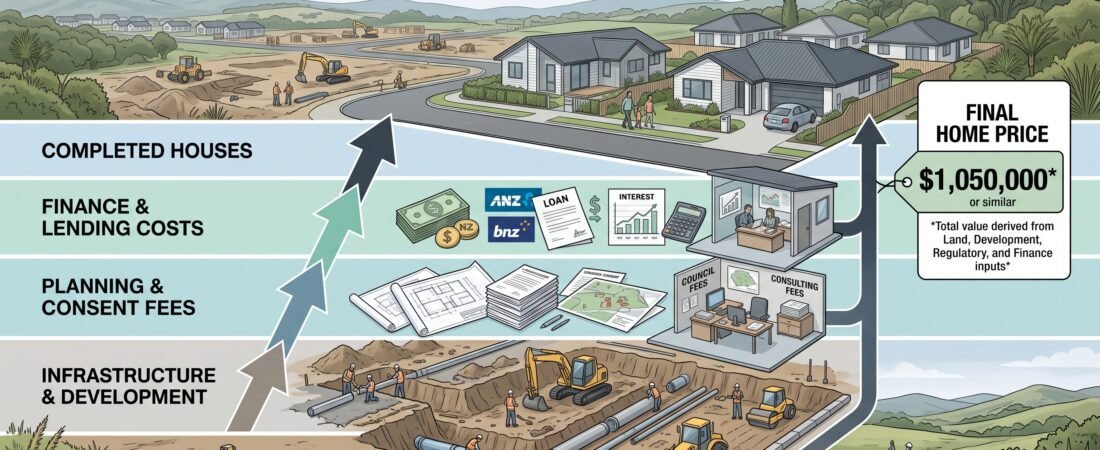
A new house is not simply the cost of timber, concrete, labour and appliances. Long before construction is finished, its final price already reflects the cost of land, infrastructure, financing, planning requirements, consenting, development contributions and delays.
That is why New Zealand can increase housing construction while affordability remains under pressure.
The more useful question is not simply:
How many homes are we building?
It is:
What makes each additional home so expensive before anyone moves in?
Explore more evidence in our Data & Truth library.
Land Is Part of the Housing Cost
New Zealand does not lack physical land.
The more important issue is how much land is actually available for development in the places where people want and need to live.
Land must be appropriately zoned, accessible, serviced and economically viable to develop.
When suitable development land is limited, delayed or difficult to bring to market, scarcity can become part of the price.
That cost eventually flows through to the buyer.
Planning rules therefore do more than determine what can be built. They can also influence how much developable land is available, how quickly it can respond to demand, and how much developers must pay before construction begins.
Infrastructure Determines Whether Land Can Actually Be Used
Raw land is not the same as housing-ready land.
New neighbourhoods require:
- roads
- stormwater systems
- drinking water
- wastewater
- electricity
- transport connections
- schools and public services
- digital infrastructure
Someone must pay for these systems.
If councils cannot finance infrastructure ahead of development, projects may be delayed or the cost may be recovered through development contributions, infrastructure charges or higher land prices.
The result can appear contradictory:
There may be plenty of land, while serviced and buildable land remains scarce.
Infrastructure financing is therefore a housing issue, not merely an engineering issue.
Planning and Consent Costs Accumulate
Individual planning or consent requirements can appear relatively small when viewed separately.
But development involves many stages.
Reports, engineering assessments, planning applications, professional advice, council processing, redesigns and delays can accumulate.
Time itself also has a cost.
If a development is financed with borrowed money, every additional month before completion can increase interest expenses.
Those costs do not disappear.
They ultimately become part of the cost structure of the completed housing.
This does not mean planning or safety standards should simply be removed. Good regulation protects communities, infrastructure and future residents.
The policy question is whether every requirement delivers enough public value to justify its cost and delay.
Finance Shapes What Buyers and Developers Can Pay
Housing is unusual because it serves two roles at the same time.
It is a place to live.
It is also a major financial asset.
Credit conditions therefore have a powerful effect on housing markets.
When borrowing is easier or buyers can access more credit, they may be able to bid more for limited housing and land.
Developers also rely on finance.
Higher interest rates, tighter lending conditions or greater development risk increase the cost of bringing new housing to market.
This means finance can affect housing prices from both directions:
buyers’ purchasing power and developers’ costs.
Building More Still Matters
None of this means housing supply is unimportant.
It matters enormously.
More housing can:
- reduce shortages
- increase consumer choice
- improve competition between properties
- make it easier for households to move
- reduce pressure caused by population growth
- support more efficient cities
But supply policy works best when it addresses the whole production system.
Approving more homes while land remains expensive, infrastructure is constrained and development finance is costly may increase construction without producing the affordability improvement people expect.
Housing Affordability Is a System Outcome
Housing discussions often search for one explanation.
Planning.
Investors.
Immigration.
Banks.
Construction costs.
Council fees.
Interest rates.
Each can matter.
But the housing market is produced by the interaction between all of them.
A useful way to understand the system is:
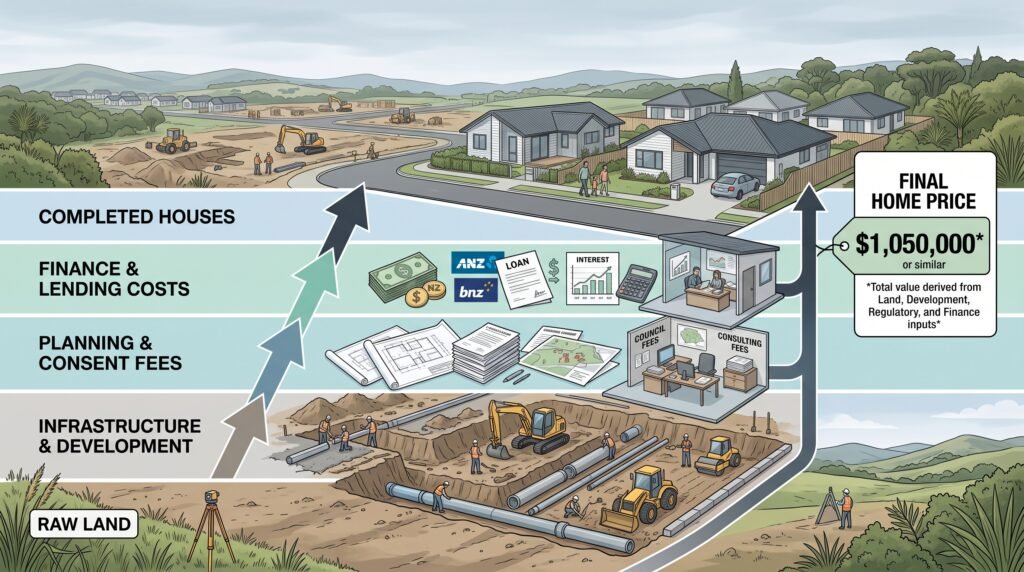
Raw land → Infrastructure → Planning and approvals → Finance → Construction → Final home price
Pressure introduced at one stage can appear later in another form.
For example, restricting land supply may increase land prices.
Delaying infrastructure may reduce development capacity.
Lengthy approval processes may increase financing costs.
More expensive finance may reduce the number of projects that can proceed.
The final buyer sees only one number: the sale price.
Behind that number is an entire system.
What Should Reform Focus On?
A durable housing strategy should examine several areas together.
1. Land availability
Planning systems should allow sufficient development capacity in locations where housing demand is likely to grow.
2. Infrastructure financing
Councils and infrastructure providers need workable mechanisms for funding new capacity without creating excessive upfront barriers to housing.
3. Approval efficiency
Regulation should protect legitimate public interests while reducing unnecessary duplication, uncertainty and delay.
4. Development finance
Policy should consider whether financing structures create unnecessary barriers to new housing supply.
5. Construction productivity
Competition, skills, materials, standardisation and technology can all affect the cost of producing homes.
6. Housing investment incentives
Tax and financial settings can influence whether capital flows primarily into existing property or into productive new housing supply.
Explore housing reform options in the FIXNZ Solution Lab.
The FIXNZ Perspective
Housing affordability is not one problem.
It is the outcome of several systems interacting.
That is why simply telling New Zealand to “build more” is incomplete.
A better approach asks:
Where does the cost enter the system?
Which costs create genuine public value?
Which costs are caused by scarcity, delay or poor coordination?
And which reforms could reduce costs without sacrificing safety, quality or long-term infrastructure capacity?
More homes are necessary.
But if New Zealand wants genuinely more affordable homes, it also has to examine what happens before the first wall is built.